
By
Neusha Karshenas
Medical Anthropology IBSc
Walking through central London, I look around at the shiny buildings despondently. This was just the flare-up of a dysphoria that’s always been humming quietly somewhere deep in my chest. How did I get to this strange place? This question sits at the heart of this piece—a meditation on diaspora, revolution, and the transformation of resilience1 from survival to resistance.
I trace the story of my dispersal back to the upheaval of my parents from their homeland: Iran. What I find is not a unique or heroic tale of upward mobility through hard work, but a story all too familiar to the oppressed. They were born in yet another nation at the mercy of corrupt governance, where normality was characterised by adaptation to tyranny and fear. Tracing the story further back (late 1970s), I find my grandfather, who suffered brutal acts of violence under the Shah’s (the King’s) repressive regime. This theme of resilience threads its way to the 2011 Syrian revolution. By juxtaposing my diaspora story with that of the Syrian revolution, I’d like to demonstrate that revolution is not a rejection of resilience but its transformation—from a forced survival mechanism into a conscious choice to resist and reclaim one’s agency.
I understand resilience as the ability to withstand, adapt to, and sometimes transform in response to stressors, shocks, or crises while maintaining coherence and the capacity to continue life.
The 2011 Syrian revolution offers insight into how people’s relationships to security and danger were reconfigured. Syria saw growing discontent with neoliberal policies, the authoritarian regime, and inhumane practices (such as shelling and enforced disappearances) that had taken root under Assad’s regime (Al-Khalili, 2023). For many of the Syrians in Al-Khalili’s ethnography, the revolution emerges as a struggle for dignity against the “zulm (oppression/injustice), khuf (fear) and fasad (corruption)” that had come to characterise their lives (Al-Khalili, 2023, 29). Though the regime’s fall brought mass displacement and loss, this suffering was often viewed as a divine test, deepening collective faith. When under a system of oppression, resilience bears the role of survival. But revolution transforms communities by restoring dignity and agency, and through this transformation, resilience can shift from something that is imposed or forced, to something that is then chosen.
Just as the Syrian people reimagined resilience through revolution, so too did the people of Iran decades earlier — the result of which deeply shaped the trajectory of my life. In 1951, the then prime-minister Mosaddeq nationalised Iranian oil after decades of the British monopoly through the Anglo-Iranian Oil Company (AIOC), which had plundered our land of wealth and sovereignty (Pirouz, 2001). But in 1953, the MI6 and the CIA helped to overthrow Mosaddeq, while the Authoritarian Shah (with the U.S.’s support) took control of Iran (Pirouz, 2001). Of course, the imperialists would not sit compliantly while their claim to international oil dwindled — explaining the need for the coup that helped overthrow Mosaddeq. This follows a heavily repeated neo-colonial tactic, whereby racial categories and constructed narratives act as justification for establishing authoritarian leaders to impose “rational” ideals on “backward” natives, by claiming they are “suffering under horrific regimes that fail to provide elementary democratic or human rights” (Omi and Winant, 2012, 317).
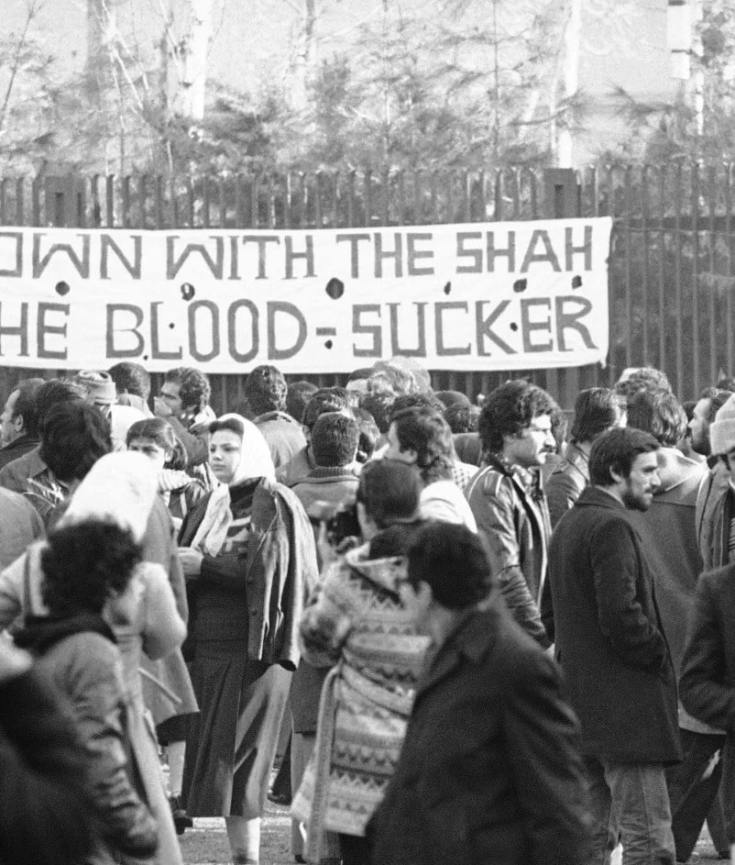
Iran under the US-backed Shah was an authoritarian one-party state, marked by impoverishing taxation policies and the SAVAK (the secret police), whose violent repression tactics included torture and imprisonment of leftist opponents (Abrahamian, 2018). Iranians fought back, through strikes, protests, and armed attacks, reaching a peak in 1979 when attacks on military bases and SAVAK offices contributed to the Shah’s overthrow (R. Keddie and Richard, 2006). In April of that year, Khomeini became Supreme Leader of the new Islamic government (R. Keddie and Richard, 2006).
Under the Shah’s regime, my grandfather had grown sick of the conditions he was living under, especially of the corruption and one-party state that formed the core of the authoritarian control in Iran. He participated in mass protests against the Shah, and just as in Syria, repression in return was violent, posing a serious risk to the livelihoods of all those present — my grandfather included. Mistaken for his friend who had given anti-government speeches at rallies, he was stabbed, and the building he was in was gunned down and set ablaze. After miraculously surviving the attack, he persisted with his previous alliances, continuing his participation in rallies and protests — demonstrating the unwavering rejection of a return to obedience.
What I’d like to note here is the agency of the subjugated, a core element often obscured from our narratives. I’d like to highlight Saba Mahmood’s (2001) notion of agency, where although we are victims to the system, we are not passive victims. We are agents, who work tirelessly to maintain dignity and values within systems of power, and sometimes against them (Mahmood, 2001). And with this, I’d like to offer not only applause to the people of Iran and Syria, but to all oppressed people worldwide.
The story in my country is not over. Waves of protests broke out after the death of Jina (Mahsa) Amini in 2022, a Kurdish woman not wearing her hijab to the police’s standards (Ghandehari, 2025). This event ignited the flame that had been building for years — years of discontent that revived a refusal to normalise resilience as survival under oppression.
I am part of the diasporic generation, landing here in London after my parents’ migration in the late 1990s. I feel cut off from what should have been my role in this revolution. That absence adds more confusion and inner conflict; this is the conflict present in much of the diaspora community. Our existence inseparably, and often forcibly, coupled with fragmentation (Hall, 2021). The dysphoria that runs through my being will remain until subalterns regain their agency through revolutionary resistance — a necessary step on the road to a more just world system.
Though my perspective on Iran is shaped by the privilege of distance, I hope that by tracing this lineage of struggle and resistance, I can both bear witness to the resilience of those at its centre, as well as providing a personal account of how such struggles manifest once trickled down across borders and generations. I’d like to conclude with some free expression — a pouring of my soul to paper after hearing some news from back home related to the recent revolution.
A survivor’s guilt
Feeling so close to the pain,
Yet far from the fire,
Questioning the basis of your anger.
History drives your legs forward,
Yet you can’t find the pavement to plant your feet,
Blood connects anguish across waters.
Airplanes disconnected you from your fate,
Yet your fallen path approaches,
Can you call this your revolution?
References
Abrahamian, E. 2018. Muhammad Reza Shah’s White Revolution. In A History of Modern Iran, 126–158. Cambridge: Cambridge University Press (available on-line: https://doi.org/10.1017/9781108182348.011, accessed 11 March 2025).
Al-Khalili, C. 2023. Waiting For The Revolution To End: Syrian displacement, time and subjectivity. UCL Press (available on-line: https://doi.org/10.14324/111.9781800085039, accessed 23 March 2025).
Andaya, E & A. Cooper. “Resilience—Peril or promise? Mapping current and future directions in the anthropology of resilience.” American Anthropologist. (available on-line: DOI: 10.1111/aman.28034, accessed 7 December 2025).
Brah, A. 2005. Cartographies of Diaspora. Routledge (available on-line: https://doi.org/10.4324/9780203974919, accessed 3 March 2025).
Evans, B. & J. Reid 2014. Resilient Life. (1st edition). Polity Press (available on-line: https://ebookcentral.proquest.com/lib/ucl/detail.action?docID=1674209., accessed 23 March 2025).
Fisher, M. 2022. Capitalist Realism. (2nd edition). Zer0 Books (available on-line: https://www.vlebooks.com/Product/Index/3103209?page=0&startBookmarkId=-1, accessed 18 March 2025).
Ghandehari, A. 2025. CONCLUSION: Woman, Life, Freedom. In Post/Revolutionary Conditions: Renewed Visions of the Iranian Freedom Struggle, 233–246. Northwestern University Press (available on-line: https://doi.org/10.2307/jj.21570592.11, accessed 18 March 2025).
Hall, S. 2021. Cultural Identity and Diaspora. In Selected Writings on Race and Difference (eds) P. Gilroy & R. W. Gilmore, 257–271. Duke University Press (available on-line: https://doi.org/10.1215/9781478021223, accessed 18 March 2025).
Harvey, D. 2005. A Brief History of Neoliberalism. Oxford University Press (available on-line: https://doi.org/10.1093/oso/9780199283262.001.0001, accessed 15 December 2024).
Mahmood, S. 2001. Feminist Theory, Embodiment, and the Docile Agent: Some Reflections on the Egyptian Islamic Revival. Cultural Anthropology 16, 202–236.
Nkrumah, K. 1965. Neo-Colonialism: The Last Stage of Imperialism. International Publishers.
Omi, M. & H. Winant 2015. Racial Formation in the United States. (3rd edition). New York: Routledge (available on-line: https://www-fulcrum-org.libproxy.ucl.ac.uk/concern/monographs/2801pk25k, accessed 3 March 2025).
Pirouz, K. 2001. Iran’s Oil Nationalization: Musaddiq at the United Nations and His Negotiations with George McGhee. Comparative Studies of South Asia, Africa and the Middle East 21, 110–117 (available on-line: https://muse.jhu.edu/article/191230, accessed 11 March 2025).
R. Keddie, N. & Y. Richard 2006. Modern Iran: Roots and Results of Revolution. Yale University Press (available on-line: https://www-jstor-org.libproxy.ucl.ac.uk/stable/j.ctt5vkwwc, accessed 17 February 2025).
Reid, J. 2012. The Neoliberal Subject: Resilience and the Art of Living Dangerously. Journal of Humanities and Social Sciences 10, 143–165.
- Resilience has been broadly understood in anthropology as “the ability to adapt to stressors and to maintain coherence as an individual, institution, or system; to survive in the face of psychic, economic, physical, or other assaults” (Andaya and Cooper 2022, 81). ↩︎
 Anthropolitan