
By
Ibrahim Ince
MA Material and Visual Culture Alumni
Pursuing graduate studies – whether that be a master’s or a PhD – comes with the usual internal question of whether you are enough for the title you are meant to embody, including delaying tasks that feel like ‘tests’ to your worthiness.
Trying to publish my master’s thesis in a journal was one of these ‘tests’ for me, which I initially put at the back of my mind for some time. It is the guidance of others who have previously taken these steps that helped me navigate this path. Upon hearing that I wanted to try publishing, an academic mentor in Cyprus motivated me to just go for it, just submit, and see what happens since I had nothing to lose. I took his advice, and I am glad I did.
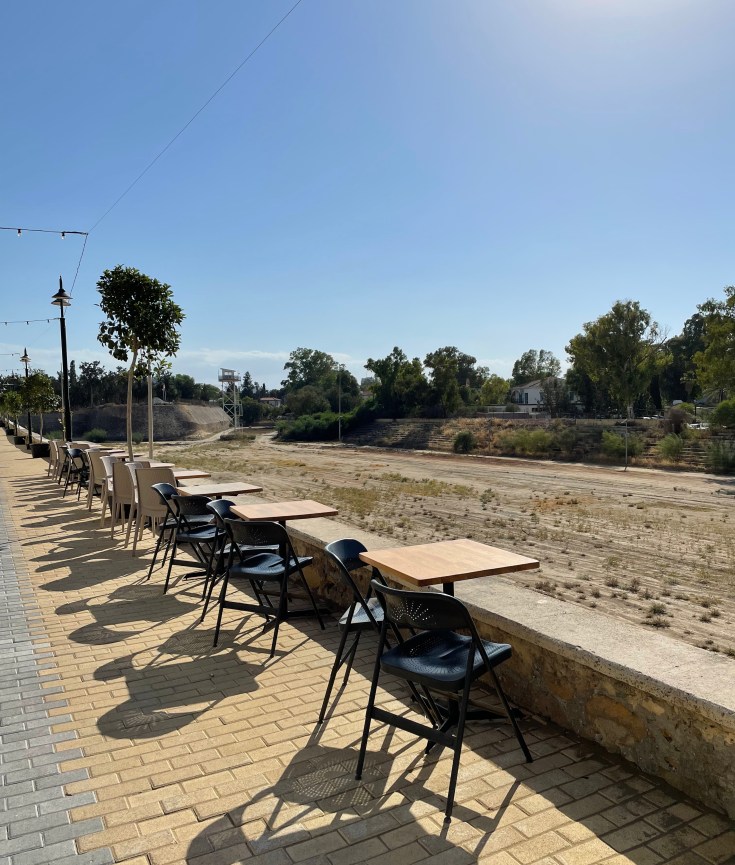
My recently published article, Border Backdrop: Shifting Visibility Along the Buffer Zone in Nicosia, is a revised version of my 2022 master’s thesis in Material and Visual Culture at UCL. My fieldwork was situated in a socially lively thoroughfare called Zahra Street, in northern Nicosia, at the edge of the Buffer Zone. Young Turkish-Cypriots visit the street to socialise, drink and gossip, with the border landscape as the backdrop[1]. Yet the landscape in question barely comes up in conversations, with other social and sensorial activities taking centre stage: the sunset and its warmth, the taste of the coffee, the gossip filling the air, and the constant Top 50 songs playing in the background.
While I initially looked elsewhere for inspiration, the research topic emerged from my own experiences. I had been frequenting Zahra Street since my teenage years and had rarely questioned its proximity to the border. This lack of questioning, shared among other young Turkish-Cypriots, became my research question. In my thesis, and subsequently my article, I explore how a border becomes invisible. I propose the term ‘backdropping’ to describe the shifting visibility of the border, depending on the people, place, and time.
I managed to secure funding from UCL to pursue a three-month ethnography in my hometown, Nicosia[2]. Through snowball sampling initiated from my pre-existing social networks, I conducted ethnographic interviews and observations with 13 young Turkish Cypriots who frequent the street and 2 business owners operating there. As is often the case with fieldwork, my findings were quite different from my anticipated outcomes. The experience transformed my thinking, leading me to accept research as an unfolding, evolving, and processual phenomenon.
Once I submitted my dissertation and graduated, the thinking behind it did not end; it continued to unfold in the ‘backdrop’ of my life. Following the motivating words of my mentors, I began cutting, editing, and developing my master’s dissertation into a journal article, asking my peers and mentors for their reflections before hitting ‘submit’. As a master’s student, the dissertation submission itself need not be the end goal. It can be a key part of an ongoing process of developing ideas, and a motivator for greater things to come.
My time at UCL informed what I ultimately proposed for my PhD project at the University of Oxford. I now explore the ways in which Cypriots adapt to the presence of a long-term border—a direct expansion of my master’s dissertation. Yet the PhD research itself has evolved and has not remained fixed to my initial proposal. My literature review in the first year, year-long fieldwork in the second year, and data analysis in the third year have fundamentally reshaped it.
As part of a processual turn, we anthropologists often talk about the things we study as processes, whether they are objects, cultures or identities. I highlight the processuality of the master’s dissertation and of research itself: to see and trust it as an unfolding, transformative process without a finish line.
Read the published article here: Ince, I. (2026). Border Backdrop: Shifting Visibility Along the Buffer Zone in Nicosia. Journal of Borderlands Studies, 1–24. https://doi.org/10.1080/08865655.2026.2613669
[1] View of the Buffer Zone from Zahra Street, northern Nicosia (2022). The chairs are all neatly up, awaiting customers to fill them, with a UN watchtower seen in the corner. Courtesy of the author.
[2] Such as the Turing Scheme Grant and the Departmental Travel Bursary.
 Anthropolitan