By
Hojin Chan
PhD Student, UCL Anthropology
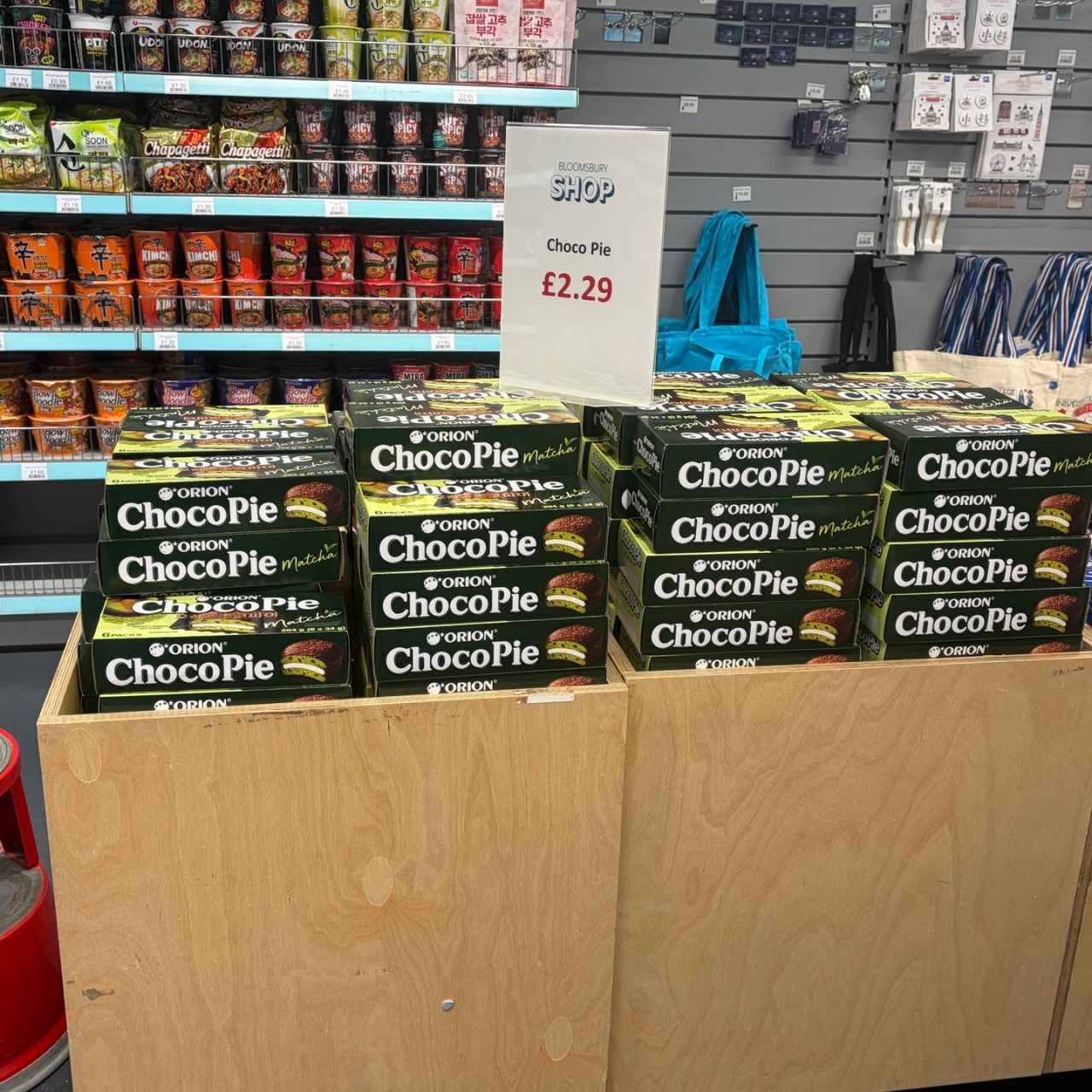
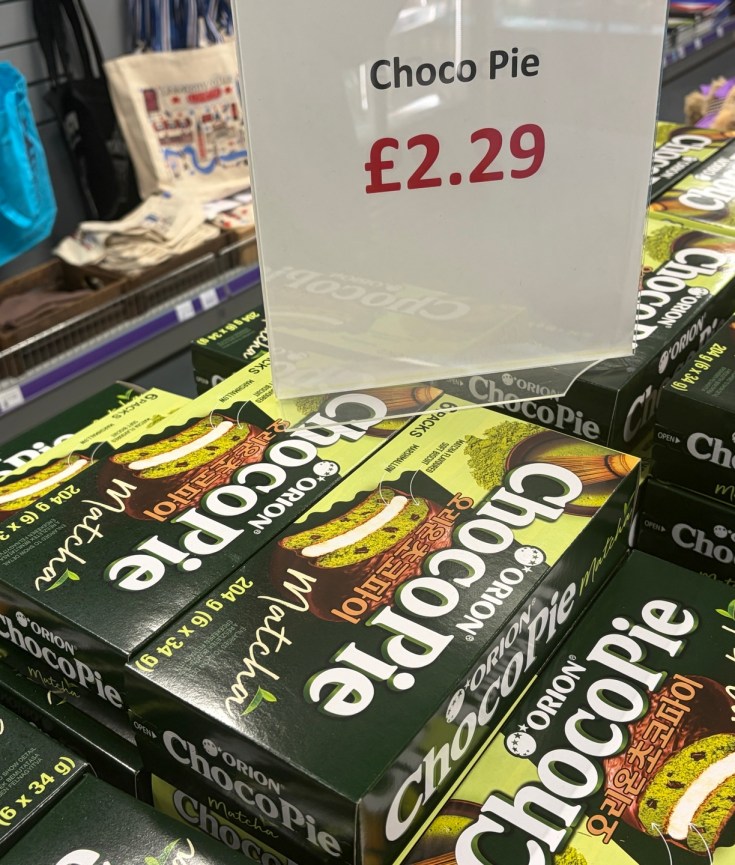
I’d been told it rains in London, but I arrived without an umbrella. After three days of getting wet, I stopped by the Student Union shop one morning to buy one. On the way to the till I paused. The international snacks section, I suppose. There, in the middle of the shelf, a Korean Chocopie. Up close, it wasn’t the chocolate one. Green tea.
The sweetness of middle-class aspiration
Chocopie, made in 1974 by a Korean company called Orion, is of course not a traditional Korean snack. The Japanese confectionery Morinaga had put out its own ‘Angel Pie’ ten years earlier, in 1961. Both go back to the Moon Pie, made in 1917 in Tennessee as a snack for American miners. True to its name, the Moon Pie was big and unapologetic — a workingman’s snack, washed down with Coke. What Orion did was take that American Southern snack and remake it in Korean form.
When Western things cross over to the East, the roots, the tensions, the context tend to drop away. What stays is the word “Western,” worn as a new identity. The Moon Pie, too, lost its miners and its workingman’s hunger when it reached Japan. There it became a middle-class dessert: smaller (5–6cm), neater, more refined. Japan was ten years into post-war growth, and the maturing middle class wanted something more “modern,” more “Western,” something closer to a proper dessert. The Moon Pie was dressed up and introduced as a cut above the everyday. The name “Angel” says the rest — Christian, Western, middle class.
Chocopie’s arrival in mid-1970s Korea was louder, the reception more explosive. Korea’s modernisation came later than Japan’s but moved faster. The 1970s were when a new middle class was just taking shape. All chocolate was imported — only the rich ate Hershey’s — and Western-style sweets were just entering the mainstream. My parents still remember Chocopie as “really delicious.” The sweetness they tasted was the first sweetness of modernity itself: the flavour of a dreamed-of West, where everything seemed good. For a parent who could buy their child a Chocopie — about a third of a bowl of noodles at the time — it was a snack of quiet pride. We feed our child this kind of thing. A snack of middle-class aspiration. A snack of economic development. The sweetness was as new and strange as the West it carried: a fantasy by the name of chocolate.
A rite of passage, sweetness after hardship
Wearing the sign of modernity and the Western dream, Chocopie arrived at the point where a new middle class met a new era of Western sweets. Then, at the pace of Korea’s own economic growth, the snack became ordinary. Mass production thinned its scarcity, prices settled into something popular, and it moved from “special” to “something you see everywhere.” By the 1980s, Chocopie was the cheap snack handed out at military PX stores — a kind of national snack. 100 won in 1976, still 150 won in 1996. It settled into working-class life as the rite-of-passage snack of Korea’s compulsory military service. The month of basic training is grueling, shocking, often tearful. On graduation day, soldiers get their first overnight leave before being sent to their new units; families wait at the gate. Well — after that kind of ordeal, body and mind, people reach for something sweet. Just as the Kentucky miners in 1917 wanted something “as big as the moon, and as sweet,” the sweetness of workingmen’s culture had, by then, migrated into Korean military life as the small sweetness one reaches for in the middle of lack.
Between chewy and airy
The parents’ generation came of age with the modern middle-class dream and lived out the growth story. The generation after — mine — grew up with long recessions and high unemployment, and may now see Chocopie as a slightly faded symbol of the age of development. A little larger than Japan’s Angel Pie (7–8cm), chewier, heavier, Chocopie has reappeared on a UCL supermarket shelf as “the taste of Korea.” Not entirely surprising that, in the Chocopie range back home , green tea – is not a typical flavour. Green tea — the East as the West imagines it — is reproduced here as Korean, inside the imagination of a marketing team. Standing in front of this more-Oriental-than-Oriental Chocopie, hair still wet, I think, a bit vaguely, of Appadurai and the social life of things. Which reminds me — when I told a friend I was coming to London to study, she asked me to bring her back an English teacake.
I still have no idea what to bring her. If you follow Chocopie’s trail backwards through history, the resistant chewiness of its gelatin marshmallow grows gradually airier, until it meets its sibling, the meringue. Japan’s Angel Pie is still a marshmallow, just less chewy. Further back, you can’t leave out the Scottish Tunnock’s Tea Cake from 1956. The industrial process that gave us the modern marshmallow emerged in 1948, so it’s interesting that the Tunnock’s Tea Cake, which arrived eight years later, chose not the easier path of gelatin marshmallow but a meringue made from egg white — even though, when nineteenth-century Americans called marshmallow “angel food,” the word covered both meringue and marshmallow. Where did all those leftover yolks go, I wonder? Were eggs a common, cheap ingredient at the time? Or did Tunnock’s Tea Cake, too, arrive as something slightly upmarket?
It should feel like the taste of home. But as I stand in front of this green tea Chocopie I’ve never once tasted, I keep thinking about small, repeated misalignments of culture — small fantasies, small misunderstandings. Perhaps the Tunnock’s Tea Cake I once tried was also someone’s oddly imagined “taste of Britain” — the thought makes me feel generous. Maybe that’s why I came to do fieldwork. Outside, the rain hadn’t stopped. At this unfamiliar umbrella stand that sells only black ones, I grow curious about what this black means. (It occurs to me that I desperately need a British friend.) I pick up a small one. I decide not to buy the green tea Chocopie. Looking past the imagined place, towards the lives of the people I’m yet to meet.