
By
Jeehwan Cha
MSc Digital Anthropology
My first visit to the UCL campus was on a cloudy day in early September 2025. When I asked whether there was a campus map at the Student Centre, a staff member kindly unfolded one and explained the spaces that students often use.
“Wow, this is really useful. Thanks. Is there anywhere nearby I should check out?”
“Oh, yes. If you go through that door over there, you’ll find the Japanese Garden. It’s especially lovely in spring, when the cherry blossoms are out.”
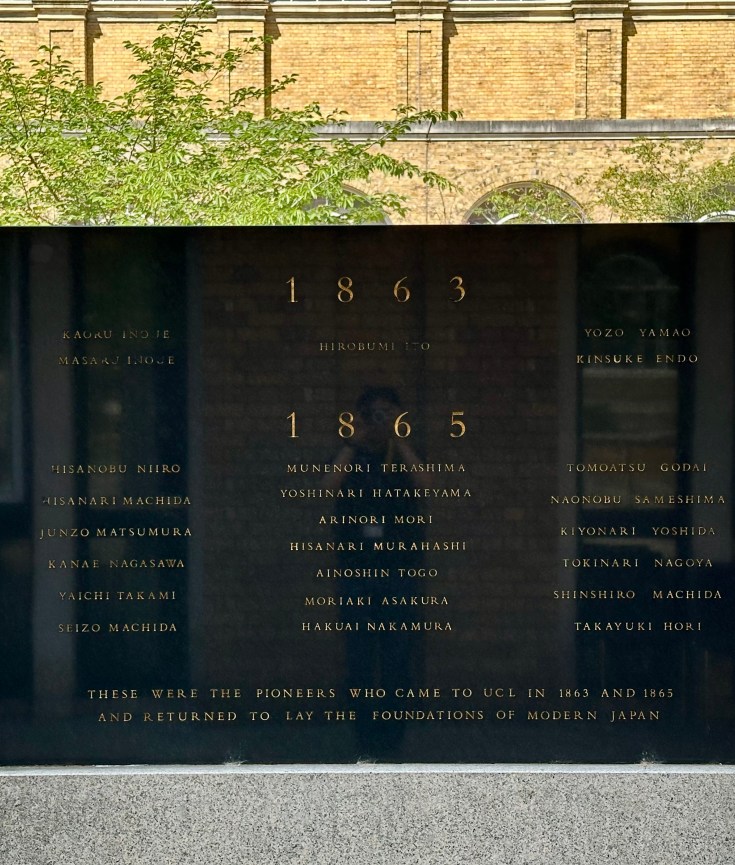
As soon as I entered the Japanese Garden, my eyes were drawn to a large monument on my left. As shown in Figure 1, it was made of smooth black granite. Near the bottom of the monument, the following sentence was inscribed: “These were the pioneers who came to UCL in 1863 and 1865 and returned to lay the foundations of modern Japan.” Above it, several names were engraved in English. Among the names on the monument, one in particular caught my attention: Hirobumi Ito.

At that moment, as a Korean, I saw the monument as something like a lenticular image: it revealed an entirely different picture when viewed from a different angle. Ito played a leading role in the colonisation of the Korean peninsula. In 1906, he was appointed as the first Resident-General of Korea, the highest Japanese authority in Korea under the protectorate system. In this sense, Ito can be understood as a figure symbolising the beginning of colonial rule, much like Warren Hastings, the first Governor-General of British India. The monument also commemorated Kaoru Inoue, who later actively led the colonisation of Korea as a senior diplomat. Yet, without any mention of the roles they later played in Japan’s colonial project, they were remembered as pioneers of modern Japan.
With the end of the Second World War in 1945, Korea was liberated from thirty-five years of Japanese colonial rule. Yet even after eighty years, the legacy of that colonialism remains present, hidden within the everyday background of UCL’s campus life. I argue that by examining the monument in the Japanese Garden and the memory practices surrounding it, we can see how this persistence is made possible through selective remembrance of the past.
Huyssen’s (2003) approach offers useful insight here. He suggests that memory can be mediated through spaces, architecture, and objects. Here, memory is a practical process performed in the present, and a dynamic relationship between the present and the past. In this sense, spaces and artefacts function as palimpsests, repeatedly overwritten by layers of memory. Therefore, in this essay, the monument in the Japanese Garden is examined as a medium of memory that UCL repeatedly invokes in order to construct its present institutional identity. It is necessary, then, to ask what forms of memory practice have repeatedly unfolded around the monument, and what kinds of public memory and narrative have been produced through those practices.
Since the monument was unveiled by the Japanese Ambassador to the United Kingdom in September 1993, it has repeatedly been invoked as a symbolic artefact whenever discourses of collaboration between UCL and Japan have emerged (Embassy of Japan in the UK, 2022; Portico Magazine, 2023; UCL News, 2017; UCL News, 2022). In 2017, the UCL President and Provost and the Prime Minister of Japan recalled having taken a photograph together beside the monument in the Japanese Garden in 2014. At that meeting, the Provost stated that the Choshu Five, the first five Japanese students at UCL, including Ito and Inoue, embodied UCL’s values of internationalisation and social contribution. In April 2022, the Japanese Ambassador visited the Japanese Garden and gave a speech beside the monument, referring to the influence that the education received by the Choshu Five at UCL later had on Japan’s modernisation and internationalisation. In 2023, UCL’s official magazine Portico described the dramatic journey through which the Choshu Five left a closed Japan and arrived in London, identifying the monument as a representative object symbolising the relationship between Japan and UCL.
These examples unfold as a romantic narrative: young men longing for an ideal future risked their lives to leave a closed country, acquired knowledge in a new world, and then returned home to contribute to making their nation more prosperous. Within this public narrative, UCL is positioned as the cradle and foundation that generously welcomed the Choshu Five, taught them modern and rational knowledge, and transformed their worldview. However, I argue that this narrative is produced through the exclusion of historical facts that unsettle UCL’s institutional self-narrative of a progressive educational philosophy. At this point, I turn from the story the monument tells to the histories it leaves unspoken.
First, this narrative either fails to mention or significantly downplays the complex realities produced by Western imperial projects when the Choshu Five studied at UCL. In 1864, less than a year after arriving in London, Ito and Inoue had to return to Japan. This was because the Shimonoseki War had broken out between nationalist forces in the Choshu region of Japan and Western powers led by Britain. Japan was eventually defeated in the war, forced to accept unequal treaties, and made to pay a large war indemnity (Britannica Editors, 2026; Cox, 2021; Kazuhiro, 2014; Japan Centre for Asian Historical Records, n.d.).
Most importantly, this narrative entirely omits the ways in which Ito and Inoue later contributed to the expansion of Japanese imperialism and colonialism (George, 2025; Kim, 2022; National Institute of Korean History, 1987a, 1987b). Ito played a leading role in concluding the treaty that deprived Korea of its diplomatic sovereignty in 1905, and later became the first Resident-General, administering Korea under Japan’s protectorate system. Inoue was involved in concluding the Japan-Korea Treaty of 1876, which first revealed Japan’s colonial ambitions, and later intervened deeply in Korean politics as Japanese Minister in Korea.
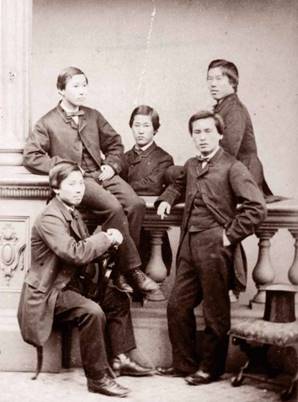
Taken together, these histories reveal a more difficult trajectory than UCL’s commemorative narrative allows: Ito and Inoue first encountered Western imperial power from a position of vulnerability, but later became colonial actors who reproduced imperial violence against neighbouring countries. The monument in the Japanese Garden commemorates the passion attached to both their youth, as students in their twenties shown in Figure 2, and their later glory, as elderly statesmen shown in Figure 3, while leaving unspoken the colonial history that connects these two moments. This selective narration recalls Adichie’s (2009) warning about the danger of a single story: by presenting only one limited perspective, it risks producing a distorted memory that obscures colonial violence and denies dignity to those affected by it.

I argue that if UCL seeks to emphasise how it contributed to Japan’s modernisation by broadening the worldview of Ito and Inoue, it must also address the colonial violence in which they were later involved. Here, I do not advance the simple normative claim that because colonialism was wrong, all practices and material forms associated with it should necessarily be removed. Huyssen criticises the reduction of all memory to trauma, and argues that the reason for remembering the past is to imagine alternatives to the present order and possible futures. From this perspective, the monument in the Japanese Garden should not be removed; rather, it should be preserved.
What is needed here is the repositioning of memory. For example, while explaining that the Choshu Five contributed to Japan’s modernisation, UCL could also state clearly that Ito and Inoue later became deeply involved in Japan’s colonial rule over neighbouring countries. Further, UCL could transform the monument in the Japanese Garden into an educational object for discussing how university education, modernisation, and colonialism were entangled with one another. This would not be an act of denying UCL’s past. Rather, it would be a way for UCL to practise the tradition of critical intelligence that it claims to uphold.
In conclusion, the monument in the Japanese Garden commemorates UCL’s progressive philosophy and the pioneers of modern Japan who studied at UCL, but remains silent about the colonial roles Ito and Inoue later played. This silence is not an accidental omission, but a political effect produced through the organisation of institutional memory in a particular way. Therefore, in order for UCL to practise a more responsible form of remembrance, it must also reveal the history of colonialism that has been excluded from this narrative.
One day in April 2026, I visited the Japanese Garden again. As the information desk staff had told me, the cherry blossoms were in full bloom. To many people, the scene may have appeared as a beautiful moment. Yet to me, just as the monument had shown me another image, like a lenticular picture, the entire beautiful garden revealed the silence that UCL’s proud narrative does not name. If UCL allows the hidden histories to be spoken, the Japanese Garden could become a place for thinking together about the relationships between modernisation and colonialism, education and power, memory and responsibility. If that day comes, I too may be able to look at the garden in a somewhat different way.
References
- Adichie, C.N. (2009) ‘The danger of a single story’. Available at: https://www.youtube.com/watch?v=D9Ihs241zeg (Accessed: 8 May 2026).
- Britannica Editors (2026) ‘Inoue Kaoru’, Encyclopaedia Britannica, 12 January. Available at: https://www.britannica.com/biography/Inoue-Kaoru (Accessed: 8 May 2026).
- Cox, S.J. (2021) ‘The battle of Shimonoseki Strait, Japan, 1863’, Naval History and Heritage Command. Available at: https://www.history.navy.mil/about-us/leadership/director/directors-corner/h-grams/h-gram-063/h-063-3.html (Accessed: 8 May 2026).
- Embassy of Japan in the UK (2022) ‘Ambassador Hayashi’s visit to University College London’. Available at: https://www.uk.emb-japan.go.jp/itpr_en/220405amb.html (Accessed: 8 May 2026).
- George, A. (2025) ‘Itō Hirobumi’, Encyclopaedia Britannica, 22 October. Available at: https://www.britannica.com/biography/Ito-Hirobumi (Accessed: 8 May 2026).
- Huyssen, A. (2003) Present pasts: urban palimpsests and the politics of memory. Stanford, CA: Stanford University Press.
- Japan Center for Asian Historical Records (n.d.) ‘四国艦隊下関砲撃事件’. Available at: https://www.jacar.go.jp/learning/term.html?uid=Y10C200010 (Accessed: 8 May 2026).
- Kazuhiro, T. (2014) Itō Hirobumi: Japan’s first prime minister and father of the Meiji Constitution. New York, NY: Routledge.
- Kim, Y. (2022) ‘The intervention of Japanese Minister Inoue in Korea and the political downfall of Dae-Won-Gun after the Gabo Reform in 1894: focused on Lee Jun-Yong’s rebellion and Kim Hak-woo assassination’, SARIM, 81, pp. 215-250. Available at: https://doi.org/10.20457/SHA.81.8
- National Institute of Korean History (1987a) ‘대일국교 조정방침과 강화도조약 체결’, Korean History Database. Available at: https://db.history.go.kr/id/hdsr_001_0010_0020_0010 (Accessed: 8 May 2026).
- National Institute of Korean History (1987b) ‘일제의 조선강점과 우익단체의 암약’, Korean History Database. Available at: https://db.history.go.kr/id/hdsr_005_0050_0010_0020 (Accessed: 8 May 2026).
- Portico Magazine (2023) ‘The Chōshū Five: makers of modern Japan’. Available at: https://magazine.ucl.ac.uk/the-choshu-five/ (Accessed: 8 May 2026).
- UCL News (2017) ‘Japan’s PM reaffirms close ties with UCL in meeting with Provost’. Available at: https://www.ucl.ac.uk/news/2017/sep/japans-pm-reaffirms-close-ties-ucl-meeting-provost (Accessed: 8 May 2026).
- UCL News (2022) ‘“Hope during turbulent times”: UCL’s pioneering work with Japan’. Available at: https://www.ucl.ac.uk/news/2022/apr/hope-during-turbulent-times-ucls-pioneering-work-japan (Accessed: 8 May 2026).
This piece is a response to Temporalities, the theme of our 2026 print issue, which you can read here.


This is a timely, justified critique of colonial amnesia and a wonderful exploration of the spatial politics of memory. By exploring how this monument valorises the Chōshū Five, you engage in a crucial act of decolonial scholarship that not only enriches our knowledge, which is, after all, the role of academia, but also challenges the naturalisation of colonial training as a legitimate vehicle for progressive education.
Of course, it should not fall to you to expose these omissions. Such erasures distort UCL’s role in nurturing those who would go on to engage in colonial violence. As a scholar-activist, I see it as an unwarranted sanitisation of history, especially when remembrance, commemoration, and reparation would be the righteous course for any university.
Your reframing of the Japanese Garden as a lenticular picture is an incredibly apt analogy. UCL has previously taken corrective measures like Bricks + Mortals to address abuses of education, memory, and institutional power. Let’s keep working together to ensure it does so again.
LikeLiked by 1 person