Time does not move cleanly through a city. It accumulates unevenly, settling into buildings, street names, and the habits of everyday life. In Bristol, the afterlife of Edward Colston’s statue shows how the past is not simply left behind, but reworked, contested, and carried forward in different forms.
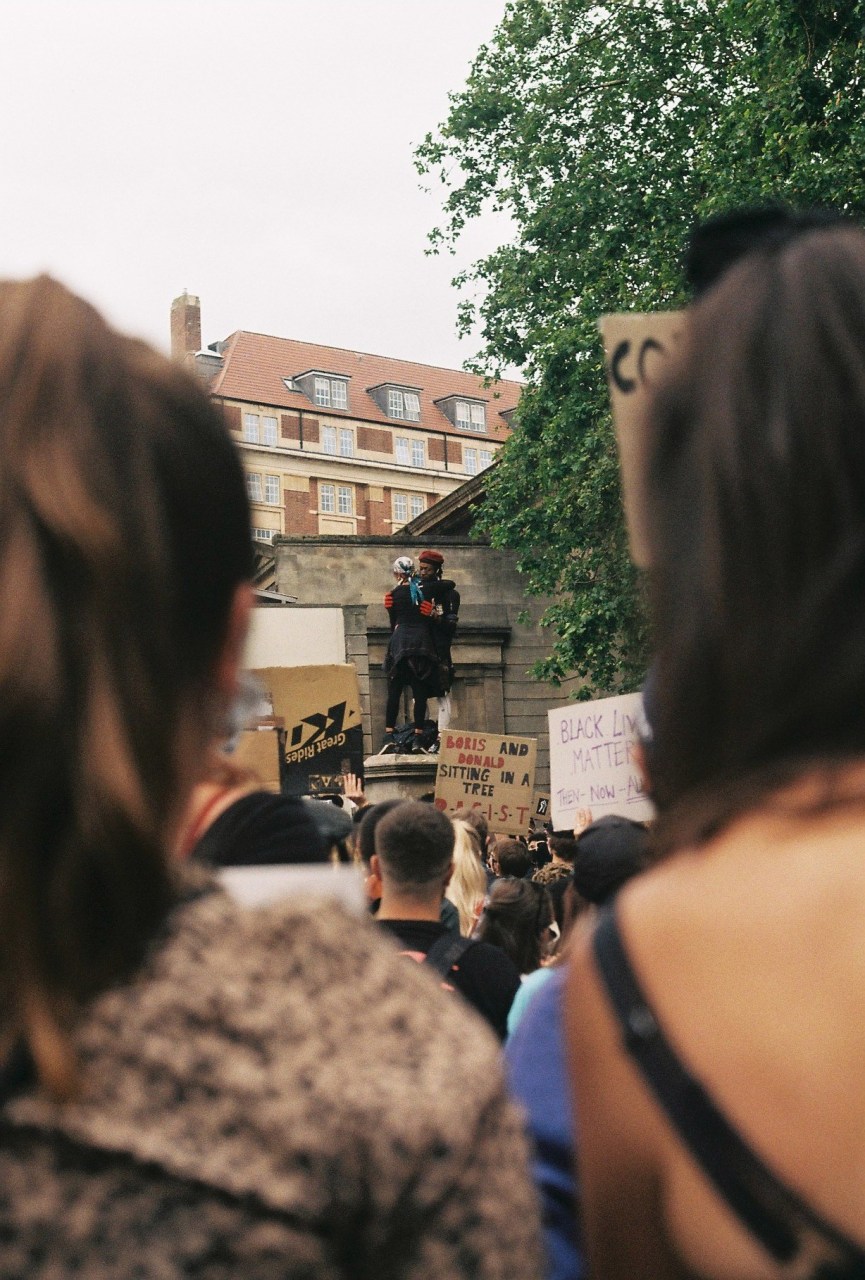
Toppled Plinth – E.Shaw, 2026
How did Colston’s statue shift from a vertical device of elite philanthropy to a dispersed set of counter-monuments, trailing from The Centre to the harbour and beyond (Cole, 2023, p. 156). The Centre, a key transport interchange and cultural site in Bristol, contains the plinth of the former statue. Now marked as “permanently closed” on Google Maps, it raises the question of whether it has ceased to function as a site of remembrance or not. Edward Colston (1636–1721), Deputy Governor of the Royal African Company (RAC), was central to the trafficking of an estimated 84,000 enslaved people, resulting in approximately 19,000 deaths during the Middle Passage voyages (The Economist, 2020; Cole, 2023, p.160). Yet the bronze statue erected in 1895, 174 years after his death, functioned as a marker of his civic virtue to the city of Bristol, which silenced his role in the slave trade. The toppling of the statue on 7 June 2020, following the murder of George Floyd and the rise of the Black Lives Matter movement, marked a decisive rupture. Through my ethnographic fieldwork from The Centre to the harbour, and the museum display, I traced four phases: inherited time, ruptured time, reconfigured time, and suspended time.
Inherited Time
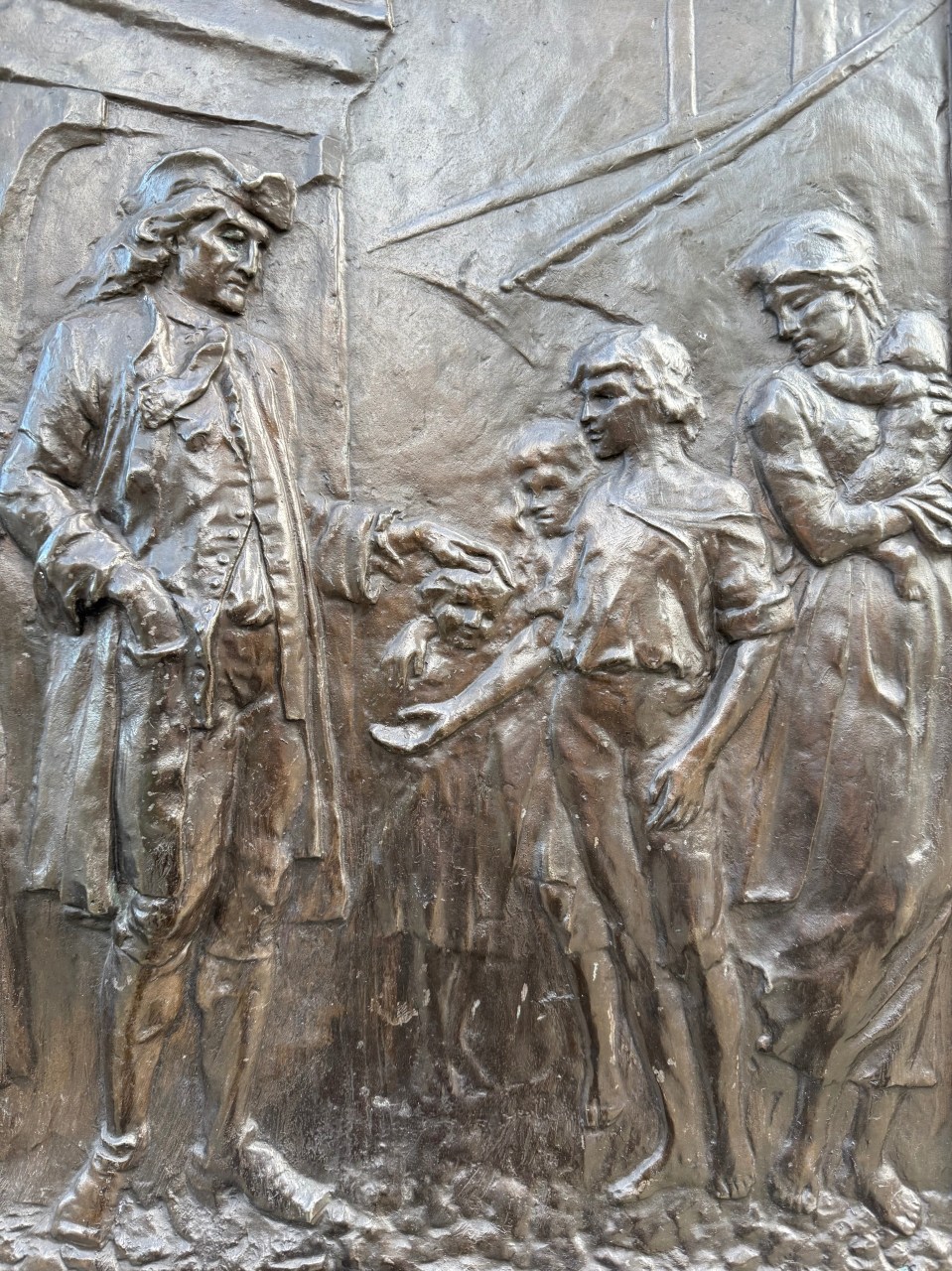
The erection of the statue in 1895 was proposed and propelled by James Arrowsmith of the Anchor Society; it functioned as a defence of Bristol’s merchant elite and their philanthropic identity (Von Tunzelmann, 2021; Cole, 2023p. 159). As Osborne argues, such monuments formed part of a “patriotic landscape” that sought to “subdue complex realities of plurality” (Osborne, 2001, p.39). The statue operated as both a “mnemonic device” and a “spatial coordinate of identity,” embedding elite values into the physical geography of the city (Osborne, 2001, p.4, 8). This selective tradition enabled Bristol to celebrate Colston’s philanthropy while the violence of the Royal African Company remained an “unscripted shadow” (Hall, 1999). The monument’s physical form reinforced this hierarchy. Elevated on a limestone plinth, Colston’s figure dwarfed the individual citizen, symbolically subsuming them into a broader imperial narrative. Here, heritage operates as a “discursive practice,” binding certain histories into a national story while silencing others (Hall, 1999, p.5). As Forty argues, material objects can become the “enemy of memory,” allowing societies to delegate remembrance to things rather than confront the past directly (Forty, 1999, p.7 ). In this sense, the statue functioned as an “agent of forgetting,” displacing the memory burden of Bristol’s slave-trading history onto the monument itself (Forty, 1999, p.7). This inheritance is not only discursive but material. Even in Colston’s absence, the bronze reliefs on the plinth continue to perform philanthropic imagery that naturalises inequality. One relief depicts Colston touching a child’s head while looking down at the poor, projecting an idea of authority and benevolence. As Macdonald’s concept of “words in stone” suggests, such imagery produces a direct “impact on the eye,” affirming a social order through visual form (Forty, 1999; Macdonald, 2006, p.105).
Bronze Relief – L. Wells, 2025
Ruptured Time
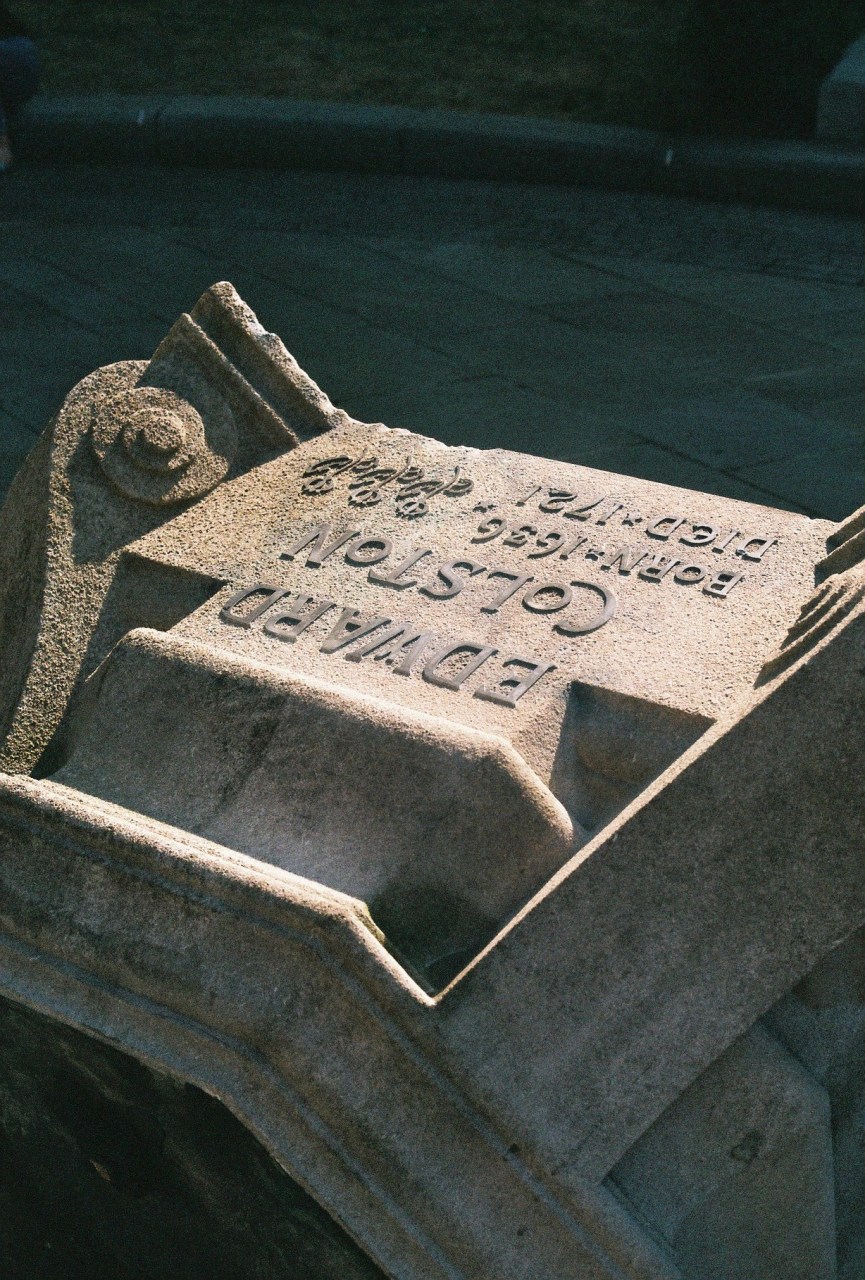
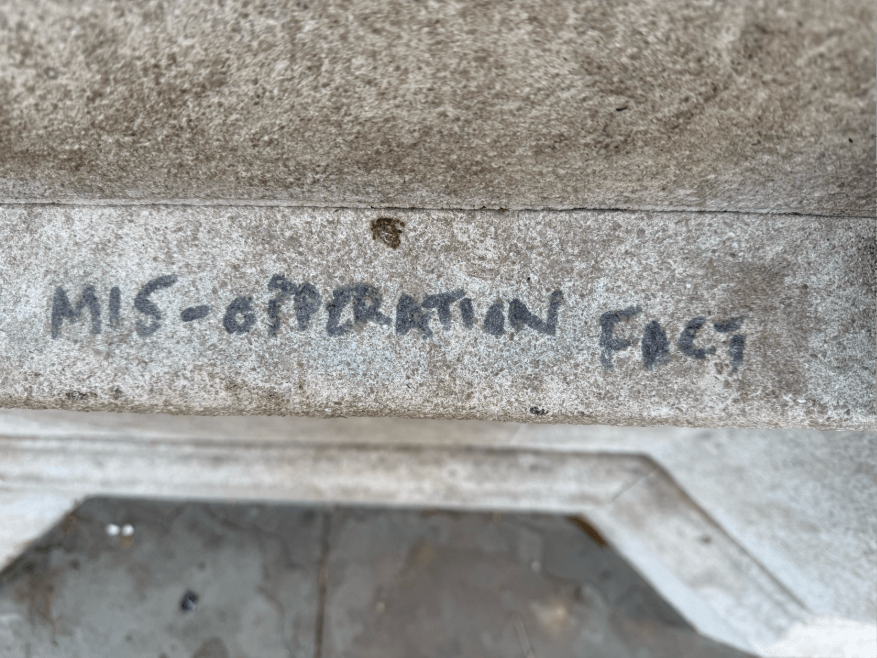
The toppling of the statue on 7 June 2020 fractured this inherited order, transforming a symbol of philanthropy into an object of embodied protest. This act formed part of a wider “global uprising against police brutality” following the murder of George Floyd (Choksey, 2021). The event unfolded through a distinct collective rhythm. The statue was shrouded, lassoed, and pulled down. Protestors then engaged in performative acts, kneeling and standing on Colston’s neck, enacting what Kisuule describes as a “standing ovation on the platform of your neck,” a radical reversal of power relations (Kisuule, 2020, cited in Choksey, 2021, p.80). In the aftermath, the plinth has come to embody a paradoxical presence. Situated within the constant movement and noise of The Centre, it is materially central yet often ignored in everyday circulation. However, its chipped edges, paint marks, and inscriptions such as “MI5 OPERATION FACT” remain as traces of the rupture. The plinth is no longer a neutral base but an artefact of racial reckoning. Even without the statue, it continues to function as an agent of forgetting. It holds the residue of the event while resisting full incorporation into the rhythms of everyday life.
On the Plinth – E. Shaw, 2020MI5-OPERATION FACT – L. Wells, 2025
Reconfigured Time
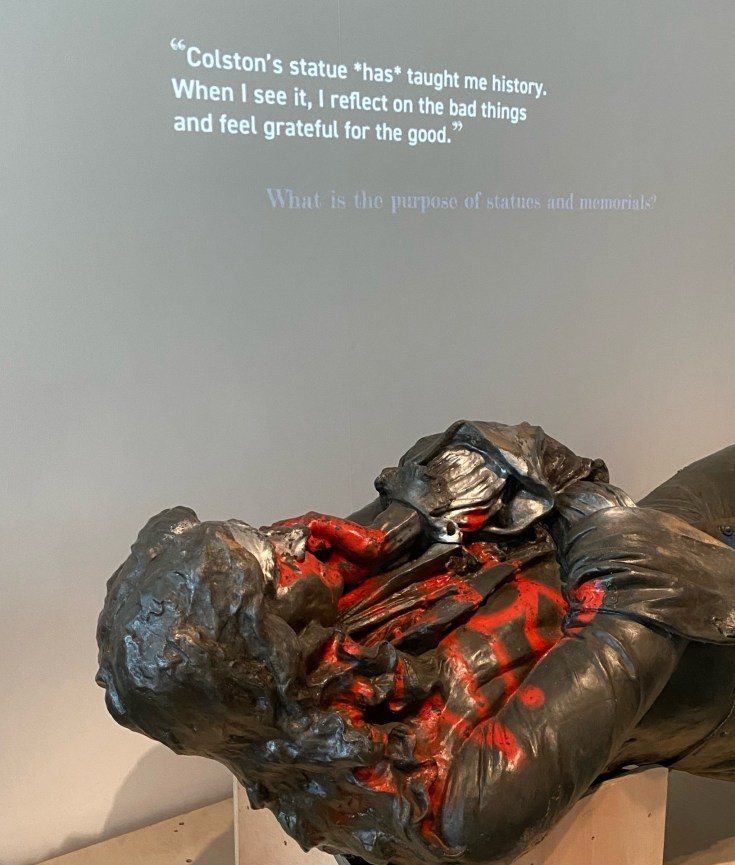
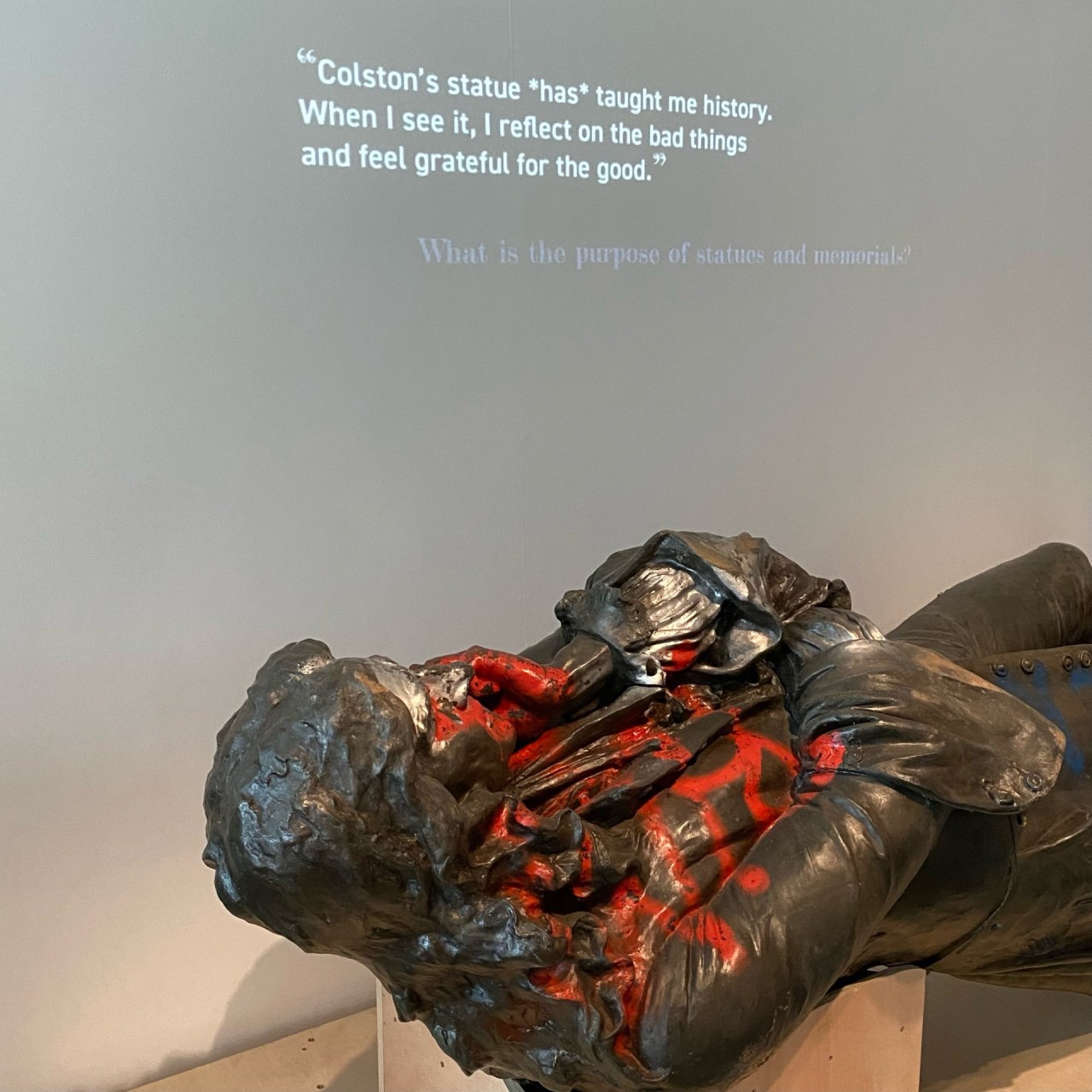
When protesters pushed the statue into Bristol Harbour, they created a counter-monument that mirrored the drowning of those lost during the Middle Passage. As Bristol Mayor, Marvin Rees, noted, the act carried a powerful symbolism: a man who profited from throwing enslaved people into water was himself returned to it (Cole, 2023, p.160). This relocation was not simply a disposal but a reconfiguration of memory. It disrupted the city’s “rational consensus,” forcing a confrontation with the histories that had been suppressed. The statue’s philanthropic narrative had long depended on the silencing of the violence that enabled it. Following its retrieval, the statue was relocated to the M Shed museum, where it is displayed horizontally in its damaged, graffiti-covered state. This marks a shift from what Macdonald describes as “vertical authority” to a “horizontal object” (Macdonald, 2006, p.110). As Barnett notes, this positioning was partly pragmatic, due to structural damage, yet it also produces a significant symbolic reversal (Barnett, 2022). The viewer is no longer required to look up in reverence but down at a broken object. The statue is stripped of its authority and recontextualised as evidence of conflict. The wooden mount, originally functional, further emphasises its transformation from sacred monument to vulnerable artefact (Osborne, 2001).
Colston Statue at the M Shed, Bristol – L. Wells, 2021
Suspended Time
Despite these transformations, the temporal status of the site remains unresolved. The Centre continues to function much as it did before, with the plinth largely ignored in everyday movement. Yet for those who attend to it, the site carries a heightened significance. My own encounters with the statue across different life stages reveal this instability. Having seen it as a child, and now returning as an analytical observer, the same site appears differently across time. The addition of a new plaque in 2024 further complicates this temporal layering. The original inscription described Colston as “virtuous and wise,” while the new text acknowledges that his legacy has been “increasingly challenged” due to his role in enslavement. However, this framing softens the violence of that history, presenting it as a matter of contested interpretation rather than systemic brutality. This produces a form of suspended time, where the site is no longer anchored in a single narrative but has not yet settled into a new one.
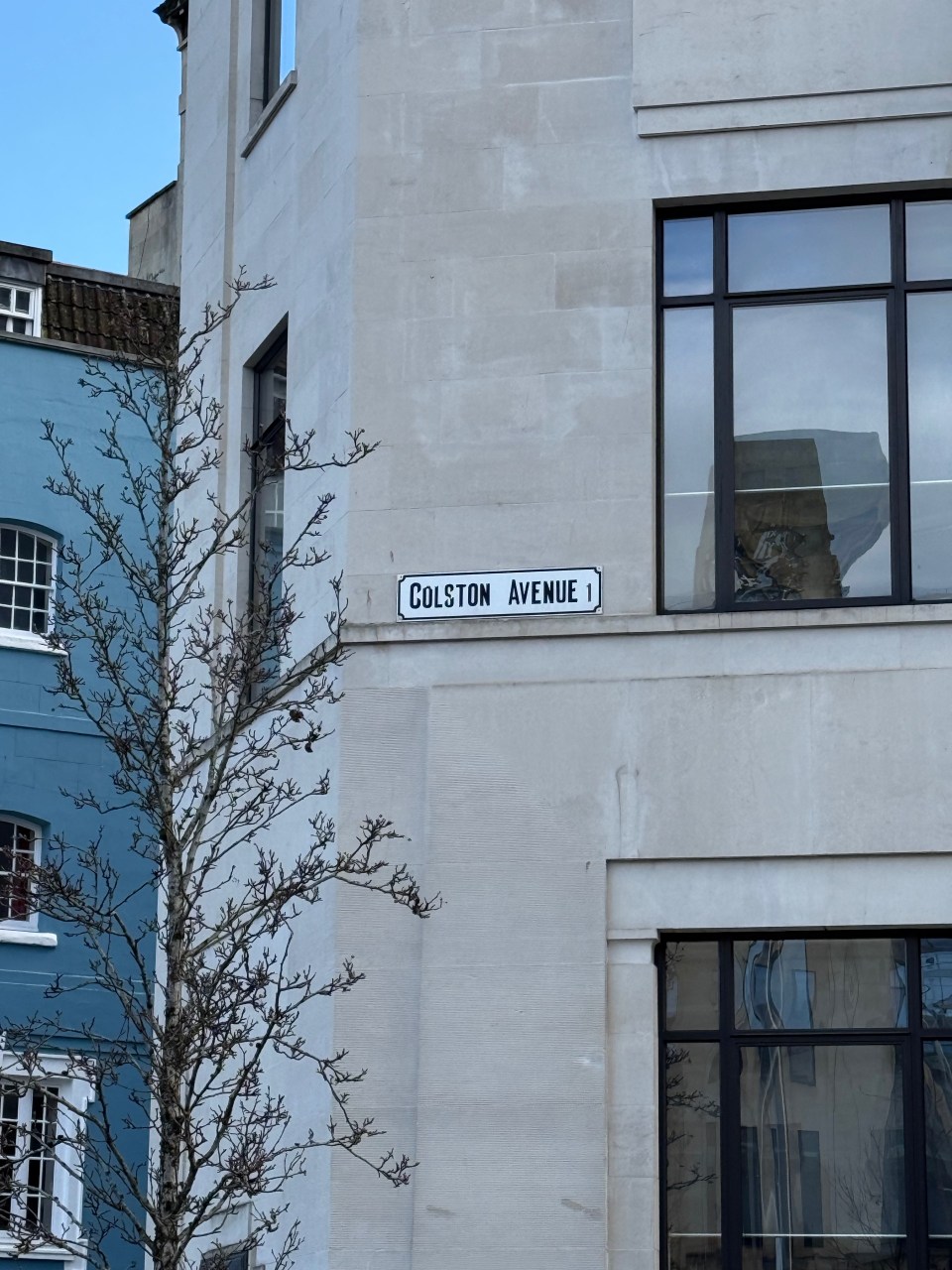
Colston Avenue – L. Wells, 2025
The Lingering Enemy
This unresolved condition extends beyond the immediate site. The presence of “Colston Avenue,” located just 100 metres from The Centre, reveals how deeply his legacy remains embedded in the city. Despite efforts to remove his name from prominent institutions, such as the renaming of Colston Hall to Bristol Beacon, traces persist. Street names function as “mnemonic devices” and such inscriptions, like “words of stone”, continue to exert meaning even in the absence of active attention. The coexistence of removed monuments and enduring names highlights the uneven nature of historical transformation. The work of de-Colstonising the city remains incomplete, raising ongoing questions about memory, power, and responsibility.
Colston’s statue has been moved from vertical monument to horizontal object, from The Centre to the harbour, from plinth to digital marker. In doing so, it has exposed the layered and contested nature of Bristol’s heritage. The statue’s afterlife demonstrates that memory is not fixed but continually reworked through material, spatial, and digital forms. The events of June 2020 were not a singular rupture but part of an ongoing reconfiguration of how the city remembers and who is permitted to author that memory. Bristol now exists as a “terrain of temporary holding places,” where multiple temporalities coexist and compete (Choksey, 2021). The question is no longer only how the city remembers, but what kinds of futures its evolving memoryscape makes possible, and for whom.
Text References
Barnett, R. (2022) ‘Displaying the statue of Edward Colston at M Shed, Bristol – a case study’, Sculpture Journal, 31(3), pp. 367–373. Available at: https://doi.org/10.3828/sj.2022.31.3.07.
Cole, T. (2023) ‘After the fall, where?: Relocating the Colston statue in Bristol, from 2020 to imaginary futures’, Journal of Historical Geography, 82, pp. 156–168. Available at: https://doi.org/10.1016/j.jhg.2023.03.001.
Forty, A. (1999) The art of forgetting / edited by Adrian Forty and Susanne Küchler. Oxford : Berg (Materializing culture).
Hall, S. (1999) ‘Un‐settling “the heritage”, re‐imagining the post‐nationWhose heritage?’, Third Text, 13(49), pp. 3–13. Available at: https://doi.org/10.1080/09528829908576818.
Macdonald, S. (2006) ‘Words in Stone?: Agency and Identity in a Nazi Landscape’, Journal of Material Culture, 11(1–2), pp. 105–126. Available at: https://doi.org/10.1177/1359183506063015.
Osborne, B.S. (2001) ‘Landscapes, memory, monuments, and commemoration: putting identity in its place’, Canadian ethnic studies, XXXIII(3), pp. 39–77.