I used to visit a coffee shop a few streets away from Hackney Central Station in London back in March 2025. There were film posters and books neatly arranged on multicoloured shelves, but it was the staff that gave the place a certain warmth; young people likely working temporary jobs, one day leaving behind to pursue ‘something else’. Yet it was precisely that ‘something else’ through the form of a shared passion for music that united them. The young Frenchman behind the counter was a former member of a post-punk band, and the head bartender was an emerging German indie folk-rock artist called SOLA1.
In one of the few conversations I had with them, I mentioned that I was conducting research on the anthropology of space and was intrigued by the human relationship with the cosmos. SOLA became interested and mentioned a book that I, too, had once begun: How Music Works. In it, David Byrne2 devotes an entire chapter to something that has fascinated musicians for centuries – something called ‘Harmonia Mundi’, which speaks to the presence of music in all things, and to its role in the organisation of the cosmos.
David Byrne’s chapter specifically takes a popular, accessible approach to the complex and historically intertwined relationship between music and culture. It touches on intriguing aspects of this relationship, such as the persuasive and political character of music, something that Theodor W. Adorno (1990), for example, explored in his analysis of the role of music in establishing specific ideologies. Overall, the idea of Harmonia Mundi is rooted in Byrne’s striking curiosity to understand the pleasurable and passionate attachment humans have to certain sounds. For him, one of the earliest major precedents in this line of thought is Pythagoras, who, driven by an obsession to understand such pleasures, developed an entire mathematical theory capturing how music is present in all things and embedded in the very principles that govern the cosmos.
In strictly musical and mathematical terms, Pythagoras suggested that proportional relationships existed between the different harmonies perceived as pleasant to the ear, and that these relationships were the same ones underlying the order of the cosmos. The conclusions derived from these relationships gave rise to the Pythagorean circle, which, despite numerous modifications, laid the foundations for modern music theory (see Anderson 1990, 36).
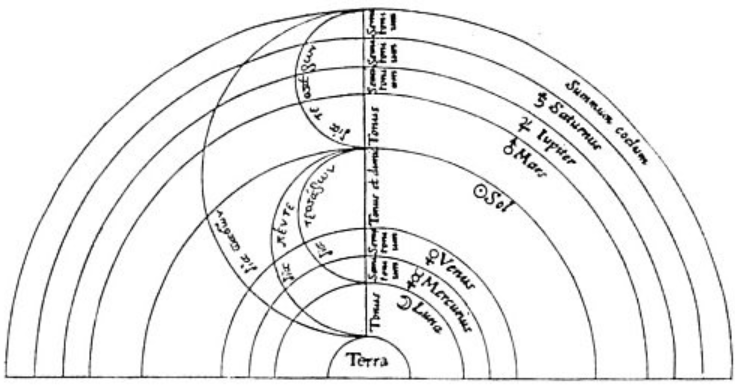
Figure 1. Simplified diagram of the Music of the Spheres, from Thomas Stanley’s History of Philosophy (17th century)
The relationship between Music, Mathematics and Magic
It was this expansion of the proportional relationships of sounds to the organisation of the cosmos that came to be known as Harmonia Mundi. According to Pythagoras, the same ‘harmonic’ intervals that govern relationships between sounds would also govern the distances between the planets. As a result, an idea emerged in ancient Greece that listening to these pleasurable sounds was synonymous with achieving a connection to the organising proportions of the cosmos.
It is precisely at the intersection of the triad of music, mathematics, and the cosmos that magic arose. By constituting a channel capable of linking the earthly world with the cosmic order, music came to be conceived as possessing magical qualities. It is therefore no coincidence that an explicit connection has been established between the figure of the musician and that of the magician throughout Western history. For example, the philosopher Boethius was imprisoned on charges of practising magic, among others, being a prominent music theorist and defender of Pythagorean ideas.
There are numerous examples throughout Western history of the persistence of these associations. For instance, in its natural revival of Greek culture, the Renaissance established a view of music that conceived it “as an ontological imprint of the divine” (Voss 2019, 1). The figure of the musician came to be that of a magical performer whose acts revealed the inscrutable connections between the human soul and the hidden principles of a divine reality (ibid., 1-4). These associations, which also involved the organisation of the everyday physical world (Voss 2019, 2– 3; DeLong and Lebrun 2019, 1), served as a creative impulse for many artists. The architect Andrea Palladio (1508-1580), for example, designed buildings in strict accordance with those same proportional principles found in music and the universe (see Byrne 2012, 335).
Disruptions and Continuities of Modernity in Harmonia Mundi
According to De Jong and Lebrun (2019, 1-2), the form of magical empiricism that had been permitted and legitimised in the Renaissance came to be challenged by a rational-scientific worldview in the 16th and 17th centuries. This promoted a modern world stripped of magic as it became associated with irrationality and error, yet the relationship among these categories persists to this day.
The rational-scientific rupture of modernity was crystallised and embodied in the figure of Newton, whose postulates reflected a duality that precisely testified to the transition toward modern science. At the core of his proposal coexisted the universalist impetus of Harmonia Mundi with the notion of “absolute, true, and mathematical time, which, by its own nature, flows uniformly, without being affected by anything external” (Newton 2016 [1687]: 54). This period is also marked by a turn to empirically verifiable experience through the study of tangible phenomena such as “sound waves, light, air, and electricity” (Gouk 2017, cited in De Jong and Lebrun 2019).
Newton came to represent the culmination of a long process that privileged objectivity above all else, a process shaped by the Renaissance obsession with order, measure, and causality (the same process underlying Harmonia Mundi). According to Denise Najmanovich (1994: 5), this calculative impulse, found in Descartes’ linear and geometric perspective, is the principal engine of the configuration of space. In temporal terms, it was precisely polyphonic music – its system of notation and its structuring of short intervals – that laid the foundation for the construction of a metrical conception of time, which ultimately formalised the notion of perfect mathematical time. This was also supported by the development of broader technical infrastructure at the time, particularly the emergence of Huygens’ mechanical clock. By Newton’s era, this conception had become intuitive and experienced as part of everyday material reality (ibid.)
However, it was also precisely in this drive toward empiricism that the inconsistency of objectivist positions lay (Najmanovich 1994, 12– 17), insofar as the focus was grounded in a kind of cognitive curtailment: the assumption of the impossibility of answering the question of origins. This, in turn, proved contradictory to the adoption of a priori notions of a unified whole without a rigorous method capable of empirically verifying it. As such, the trajectory that modernity ultimately took, following Einstein, was to move away from this universalist notion of time and instead turn toward specificity – toward the idea of multiple, contextual temporalities.
Despite the abandonment of such a unified whole, the relationship among categories such as ‘the musical,’ the magical,’ ‘the mathematical,’ and ‘the temporal’ remained at the core of Western cosmological thought. Whether as a theoretical attempt to reposition the magical and enable the reintegration of these spheres, as in Carl Jung’s challenge to causal and logical relations through his concept of synchronicity (2013 [1954]); whether through explicit calls in the arts to revitalize the notion of Harmonia Mundi, as advocated by filmmakers such as Walter Murch; whether through initiatives like NASA’s 1989 album Symphonies of the Planets(Drake, 2016), which romantically gestures toward the possibility of such a relationship; or even through the strong exclusion and opposition to the magical, for example, through Sigmund Freud’s (1913) view of magic as a form of intellectual laziness aimed at a simplified understanding of the cosmos – the relationship among these terms, albeit in diverse forms, continued to persist throughout the centuries that followed.
Reticulations: A Network Perspective on Music of the Spheres
It is precisely for the above reasons that the musical, the magical, and the mathematical can be conceived not as fully fixed entities or events with static definitions, but rather as meanings, practices, and objects that remain continuously open to reticulation – that is, to networks of diverse natures in which cultural meanings and values become entangled with objects and human practices, giving rise to specific cultural realities from which official interpretations and categories such as ‘magic’ emerge.
Framed within a Simondonian analytical perspective, and following Ludovic Coupaye (2025; 2022; 2018), this approach makes it possible to focus more closely on the preceding processes of reticulation through which phenomena such as sound become entangled with other elements, practices, and objects, while also recognising that these processes are highly susceptible to contextual variation. It is therefore crucial to observe the reality that precedes the analytical act by which these spheres are segmented, situating them instead on a non-differentiated plane of immanence3 in which such distinctions have not yet fully emerged.
Thus, music would not be understood as something that inherently carries or is intrinsically attached to the cosmos. Rather, what matters is understanding the rearticulation of sonic phenomena with many other elements – both physical and non-physical – within specific vernacular contexts in which those connections may occur in different ways. The aim is to examine how such entanglements configure and bring forth a cultural reality, together with the unique ontology (of categories such as ‘music,’ ‘magic,’ or ‘cosmos’) through which a culture inhabits the world.
This perspective enables a more context-sensitive intercultural analysis, one that moves toward a vernacular understanding of how reticulations occur in concrete historical, communal, and social contexts, without assuming in advance – or treating as inherently embedded in reality – any fixed perception of what is musical, cosmological, magical, or temporal.
In this sense, an essentialist position would not be viable, one in which music is understood as something in itself without considering all the relations with other elements on which it depends. Rather, it would be part of a more complex network that both manifests and re/produces a specific cosmology; and which, as a consequence, would involve the mobilisation of a conception of the material world and a field of human behaviours oriented toward the concrete.4
This perspective allows us to see how the sonic event is immersed in a field of varied reticulations, openly enabling the interpretation of different cultural and historical contexts. It gives way to the possibility for arguing that Harmonia Mundi corresponds to a concrete set of reticulations, and that contemporary responses, such as David Byrne’s, are an attempt to return to it.
Footnotes
1 Names are pseudonymised for this piece.
2 David Byrne is a Scottish-American musician and multidisciplinary artist best known as the lead vocalist and principal creative force of the rock band Talking Heads. Born in 1952, he has also produced notable written work, including books, forewords, and screenplays.
3 Following the arboreal thought of Gilles Deleuze and Félix Guattari (2006 [1980]) in which the relations between them form a continuous relational whole, where the act of naming such categories is posterior to the non-segmented nature through which they reticulate.
4See Yuk Hui (2017) on the idea of cosmotechnics.
References
Adorno, Theodor W. 1990. “On Popular Music.” In On Record: Rock, Pop and the Written Word, edited by Simon Frith and Andrew Goodwin. London: Routledge.
Anderson, Gordon H. 1983. “Pythagoras and the Origin of Music Theory.” Indiana Theory Review 6 (3): 35– 61.
Byrne, David. 2012. How Music Works. Edinburgh: Canongate Books.
Coupaye, Ludovic. 2018. “‘Yams Have No Ears!’: Tekhne, Life and Images in Oceania.” Oceania 88 (1): 13– 30.
Coupaye, Ludovic. 2022. “Danse avec les catégories: anthropologie de la «technologie» et anthropologie des techniques.” Artefact. Techniques, histoire et sciences humaines 15: 127– 50.
Coupaye, Ludovic. 2025. “Ontology in the Making or Ontogenesis? Yams and Printers as Autonomous Objects and Their Milieus.” In Ontologies in the Making: Anthropological and Archaeological Perspectives, edited by Q. Letesson, L. Simon, and J. Driessen, 95– 113. Louvain: Presses Universitaires de Louvain.
De Jong, Nanette, and Barbara Lebrun. 2019. “Introduction: The Notion of Magic in Popular Music Discourse.” Popular Music 38 (1): 1– 7.
Deleuze, Gilles, and Félix Guattari. 2006 [1980]. A Thousand Plateaus: Capitalism and Schizophrenia. Translated by José Vásquez. Valencia: Pre– Textos.
Drake, Timothy. 2016. Symphonies of the Planets (Complete NASA Voyager Recordings) [CD].
Freud, Sigmund. 1913. “Animism, Magic and the Omnipotence of Thoughts.” In Totem and Taboo, 1– 161.
Gouk, Penelope. 2017. “Vibrations cosmiques. Échos de l’harmonie universelle aux temps des Lumières britanniques.” Terrain. Anthropologie & sciences humaines 68: 26– 45.
Hui, Yuk. 2017. “On Cosmotechnics: For a Renewed Relation between Technology and Nature in the Anthropocene.” Techné: Research in Philosophy and Technology 21.
Jung, Carl Gustav. 2013 [1952]. Synchronicity: An Acausal Connecting Principle. London: Routledge.
Najmanovich, Denise. 1994. “De ‘El tiempo’ a las temporalidades.” In Temporalidad, determinación, azar. Lo reversible y lo irreversible, edited by Silvia Bleichmar. Buenos Aires: Paidós.
Newton, Isaac. 2016 [1687]. The Principia: Mathematical Principles of Natural Philosophy. 1st ed. Berkeley: University of California Press.
Voss, Angela. 2019. “Music and Magic.” In The Cambridge History of Sixteenth– Century Music, 472– 501. Cambridge: Cambridge University Press.
This article is a response to Temporalities, the theme of our 2026 print issue, which you can read here.