
By
Rie Kimoto
MSc Anthropology and Professional Practice
“Dead bodies are buried under the cherry trees! For how can it be believed that cherry blossoms bloom so brilliantly otherwise?”
Motojiro Kajii, Under the Cherry Trees (1928)
After a long, dark winter, spring has finally arrived in London. Observing the cherry blossoms at Spa Fields Park in Farringdon, I was struck by a sense of unease. This essay is a record of the shift in my perception of these trees, which only a year ago I viewed as mere objects of beauty. Through a multispecies ethnography of Spa Field’s cherry trees, I explore how urban parks are not simply aesthetic green spaces of the present, but rather sites where the past, present, and future intertwine.
What, then, has changed since last year? The difference lies in my knowledge regarding this land’s uncomfortable inheritance. In fact, between the 18th and 19th centuries, this park served as a severely overcrowded cemetery. Approximately 8,000 bodies were interred in a plot with a capacity for only 2,722. Older remains were disturbed, and corpses were illegally incinerated. The resulting smoke and pollution caused severe health hazards until a public exposé in 1845 led to its closure and eventual reorganisation into a community park. Although the remains of the past have presumably merged into the present-day soil, the complete removal of headstones makes it difficult to recognise the site’s former existence as a cemetery.
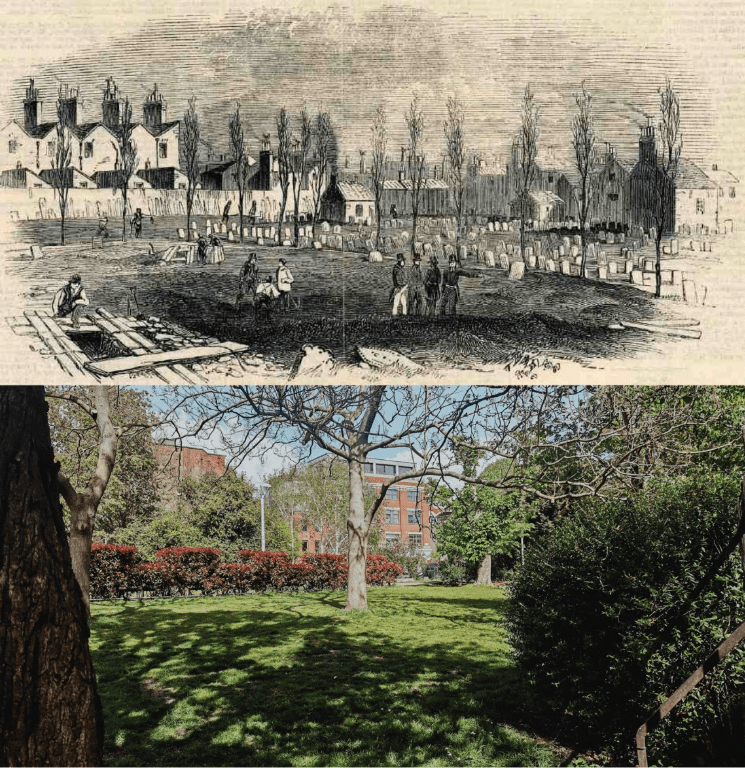
From the perspective of urban planning, Spa Fields might appear to be a success story, a hazardous cemetery transformed into a clean green space, decoupled from its history of pollution and death. However, as Worpole (2003, 157) warns, modern urban planning has historically sought to thoroughly and irreversibly exclude inconvenient corpses and the memories of the past from the landscape. In doing so, this process creates “cities that deny death and humanity” by severing the historical continuity of dialogue between the living and the dead (ibid., 31). At Spa Fields, manicured lawns and cherry blossoms veil the temporal connection to the site’s history as a cemetery.
Cultural Perception: Deconstructing the Aesthetics of Cherry Blossoms and Death
To pierce through this aesthetic veil and re-evaluate the landscape’s hidden past, the figure who came to mind was the Japanese writer Motojiro Kajii (1928). His famous opening line, “Dead bodies are buried under the cherry trees!” is part of an influential short story that links the imagery of cherry blossoms with death in Japan. Within this narrative, the protagonist feels a profound dread at the uncanny perfection of the blooming flowers, convincing himself by rationalising that such suspiciously brilliant beauty must be actively drawing nourishment from the rotting corpses buried beneath.
Before learning of its history, the cherry blossoms of Spa Fields were simply beautiful features. But the moment I became aware of the horrific history of the improperly processed remains, my perception was reorganised through this Kajii-esque lens. My internalised cultural template inverted the role of the blossoms. The trees shifted from being entities that severed the present from the history of death to ones that actively bound them together. Initially, this felt like a success – a shift from superficial consumption to a multi-layered temporal awareness of the soil’s grim eighteenth-century inheritance.
However, as my ethnography progressed, it became clear that even this inversion was itself a form of blindness. From the moment the cherry buds began to swell until the brown, shrivelled petals were finally subsumed into the soil, I made repeated visits to a small plot at the foot of a single cherry tree. This was my exercise in what Tsing (2015, 37) terms the ‘art of noticing,’ a practice of temporarily setting aside human-centred frameworks of meaning to intentionally attune one’s senses to the overlooked details of a reality where humans and non-humans entangle in unexpected ways.
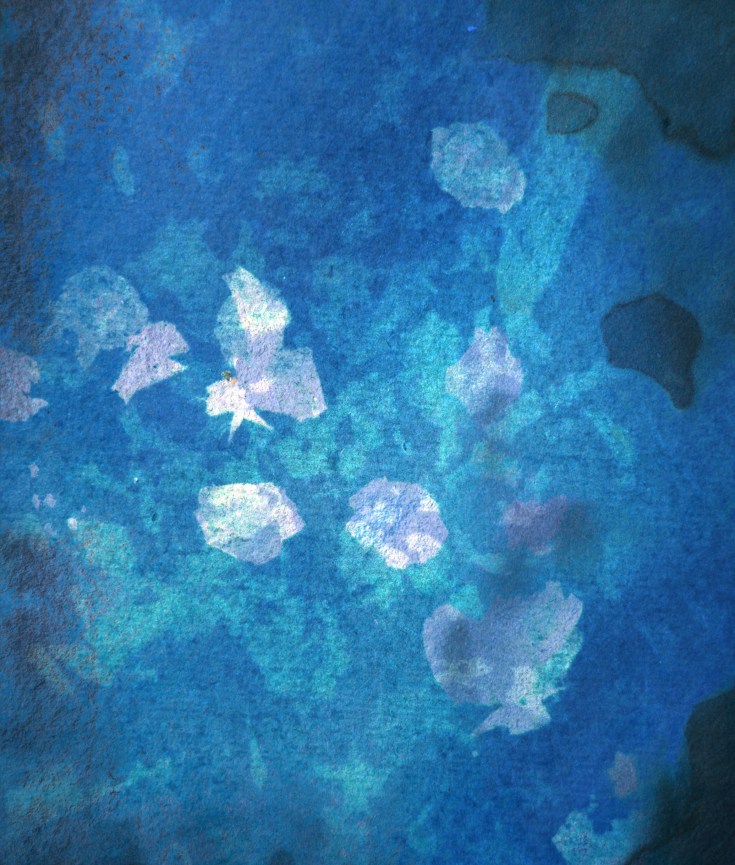
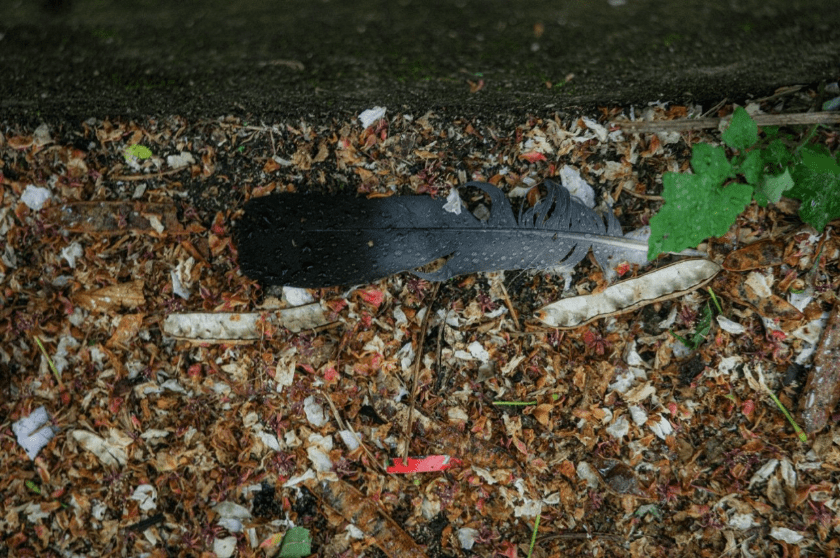
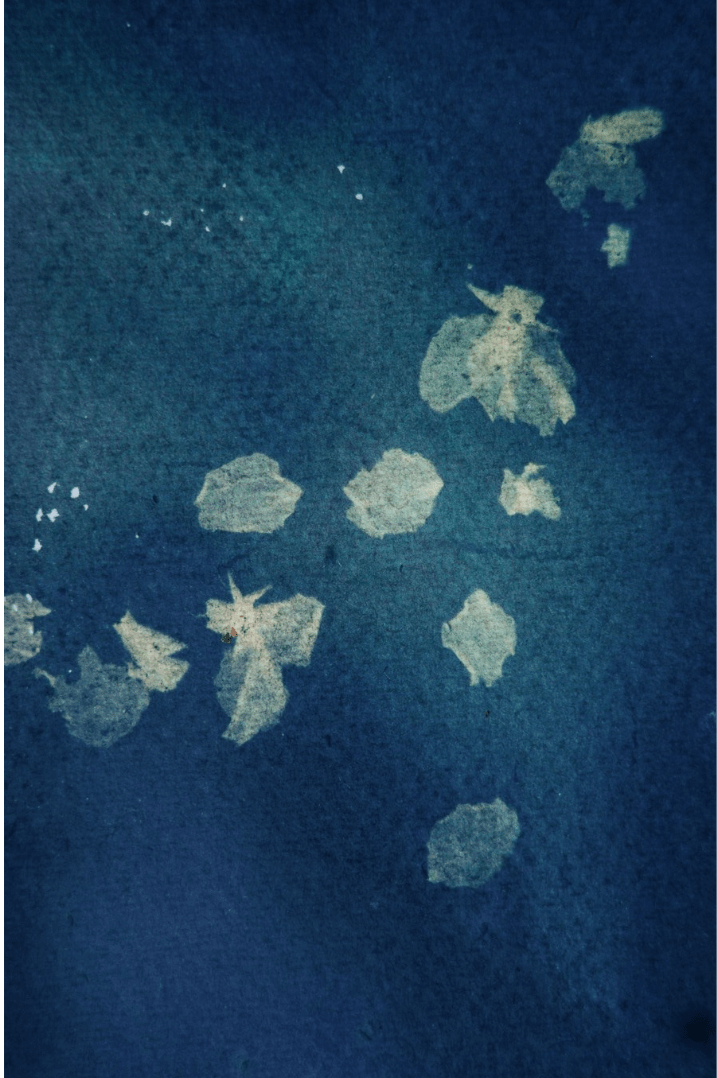
Throughout the research period, I created cyanotype sun prints as a visual diary, using petals, feathers, hair, and fragments of plastic gathered from beneath the cherry tree. I chose the cyanotype because both the invention of this photographic technique and the burial crisis at Spa Fields unfolded during the same era in nineteenth– century Britain. While rapid industrialisation sparked the emergence of new technologies and brilliant inventions like the cyanotype, it simultaneously drove the drastic densification of cities and the resulting pollution of overcrowded cemeteries.
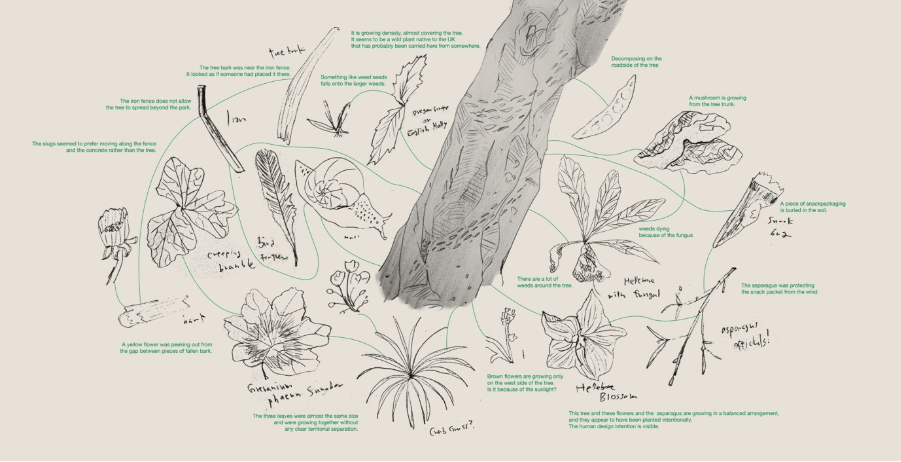
The cherry blossoms I gathered during this process were not symbols of beauty as Kajii had depicted. Instead, they were half-submerged in the soil, entangled with human hair, feathers, and plastic. Touching them, I was struck by a profound sense of unease. Part of this was a lingering anxiety regarding the past, an imagination haunted by the remnants of corpses resting beneath, yet it was simultaneously a more visceral, intuitive repulsion toward the immediate filth, an urgent desire to scrub away the grit trapped beneath my fingernails. Through this fieldwork, feeling both past and present anxieties at my fingertips, I realised that by being so consumed by the dark inheritance of disturbed corpses, I had become blind to the complex entanglements of the present, a state in which the past is perpetually decomposed and metabolised into an unknown future.
I began to feel a sense of dissonance with the very way cherry blossoms are narrated in Japanese literature as objects of ‘pure, overwhelming beauty’. The blossoms I encountered were invariably ‘dirty,’ caught within messy entanglements. Had the protagonist of Under the Cherry Trees directed his attention to the multispecies entanglements surrounding the trees, the overlapping temporalities where remains return to the earth to foster new life, perhaps he would never have found himself trembling before the spectres of the blossoms.
From the Soil: Imagining the Future through the Past and Present
Throughout this fieldwork, my perspective has undergone a gradual transformation. Initially, I enjoyed Spa Fields simply as a clean, beautiful space. Later, upon learning the history, I began to read the contemporary landscape as an inheritance of the past. However, sifting through the entangled debris, I sensed a third temporality. It is not a time where the past is silently preserved beneath the present, but one where it is constantly being decomposed, metabolised, and carried forward into the future through plants, microbes, and urban refuse. At Spa Fields, ‘now’ is not merely the consumable spring of 2026. It is an ongoing process in which the remnants of the dead from 1845, nineteenth-century chemicals, contemporary urban waste, and the cherry trees, moss, insects, plastics, and microbes are perpetually entwined, transforming one another into new forms.
In the Anthropocene, the ‘art of noticing’ (Tsing 2015, 37) may perhaps be the act of reconnecting the past, present, and future – temporalities that the managed city seeks to decouple through our own bodily senses. Plunging my fingers into the mud and picking up soiled cherry blossoms was an act of receiving the weight of the land’s inheritance with my own body. Simultaneously, it was a modest response, an inquiry into what kind of future we should carry this weight into.
What is buried under the cherry trees is not only corpses. Just as the withering petals and tiny fragments of debris left the same ghostly white outlines on the blue-scorched cyanotypes, what resides there is an endless question: the realisation that the past and present, human and non-human, life and death, the decomposable and the non-degradable are handed down to the future, inextricably entwined.
References
Islington Local History Centre. 2005. EC1 Local History Trail. London: Islington Council. Accessed April 2, 2026.
Kajii, Motojirō. 1928. “Sakura no ki no shita ni” [“Under the Cherry Trees”]. Accessed April 18, 2026.
Survey of London. 2008. “Exmouth Market Area.” In Survey of London: Volume 47, Northern Clerkenwell and Pentonville. London: London County Council. Accessed April 24, 2026.
Tsing, Anna Lowenhaupt. 2015. The Mushroom at the End of the World: On the Possibility of Life in Capitalist Ruins. Princeton: Princeton University Press.
Worpole, Ken. 2003. Last Landscapes: The Architecture of the Cemetery in the West. London: Reaktion ooks.
This piece is a response to Temporalities, the theme of our 2026 print issue, which you can read here.

