
By
Hayley Soh
BSc Anthropology with Year Abroad
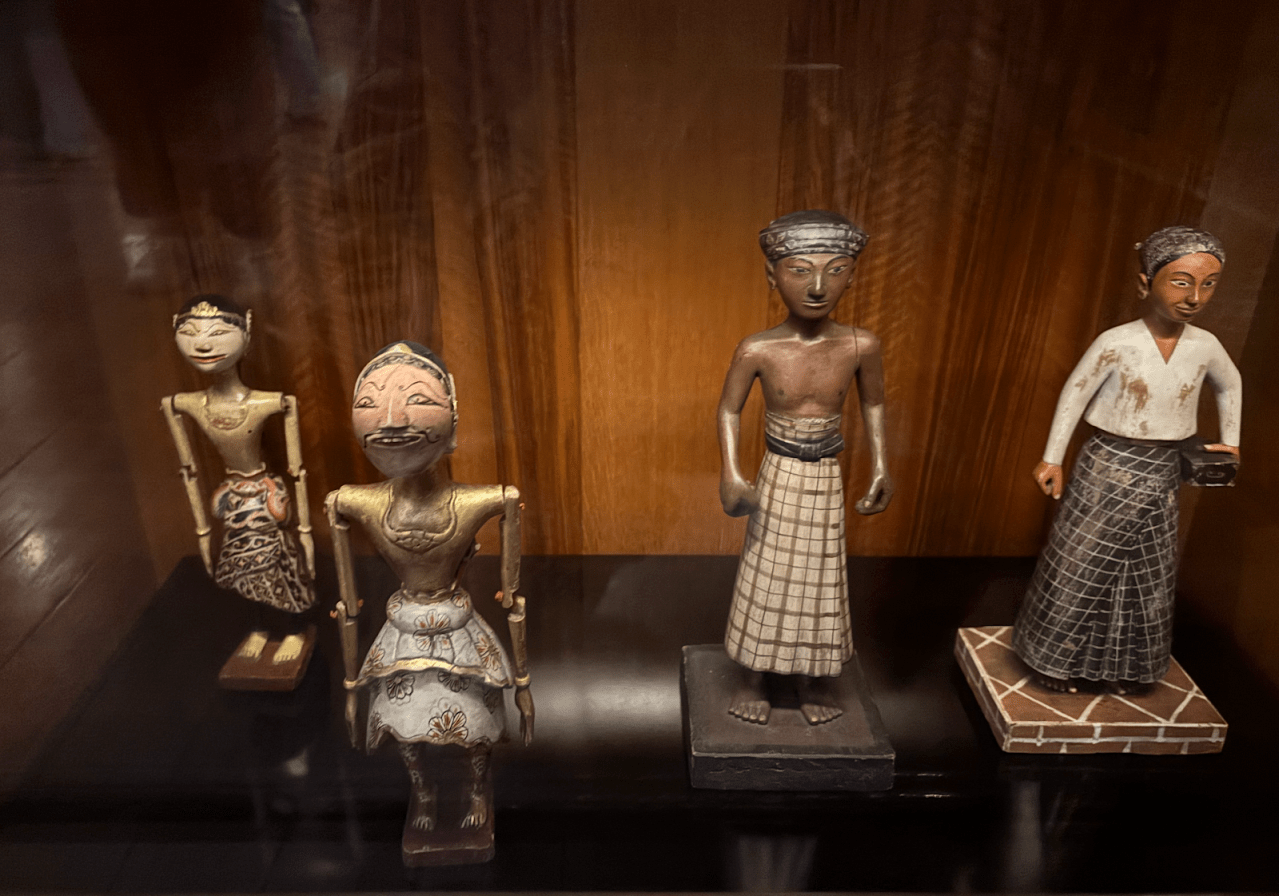
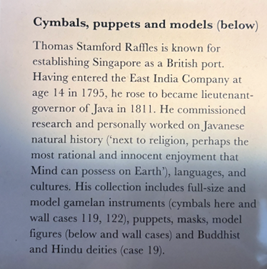
When I visited the British Museum, I happened to chance upon a display of Javanese puppets and models tucked away in one of its many galleries. Had I not read the label carefully, I wouldn’t have thought that the puppets were Javanese. Instead, the label focuses on British colonial officer Sir Stamford Raffles, his exploits in the Dutch East Indies and how he ‘established’ Singapore as a British port. As a Singaporean, this made me think: if our museums and textbooks are still centred on colonial exploits, where do we even begin to talk about ‘decolonising’ anthropology?
Deeply entangled in colonialism, many early collections were often only made possible through imperial networks of expansion and extraction, as well as scientific explorations during the Age of Enlightenment. These collections were stored and displayed in wunderkammern, or cabinets of curiosities, curated personally by the explorer/owner and not open to the public. The issue with these predecessors of modern-day museums was that the way they were curated was a direct reflection of the curator’s personal worldview, often impartial and holding significant racial prejudices.
This system of arbitrary classification along the lines of ‘racial hierarchy’ was inherited by early museums. For example, the Pitt Rivers Museum in Oxford was originally arranged to show the development of material culture from simple to complex, suggesting which items were civilised and which were not. This imposes binary divisions on humanity, categorising people like exhibits in the spirit of unilinear evolution, where racist beliefs are physically materialised in the form of cabinets of curiosities, institutionalising and reinforcing certain worldviews as factual and credible knowledge. This is exacerbated by the private nature of the collections, only accessible to an elite few, reinforcing the divide between the cultured rich and the uncultured poor. Cabinets of curiosities exoticise the Other, treating non-Western cultures as objects to be collected instead of genuine realities to be understood.
The contemporary museum has responded to the call to ‘decolonise the museum’ by decentring colonial narratives and democratising access to knowledge. For example, the Auckland War Memorial Museum displays rocks in two ways: one categorised in the scientific way and one in the Maori way (based on their relationship to the gods and their role in local customs and stories), presenting them as different but equally valid ways of interpretation.
The issue of coloniality is not limited to the space of the museum. In my home country Singapore, I see the colonial legacy bleed into aspects of daily life. Our educational system largely centres our history on the period of British colonisation, on Raffles’ establishment of Singapore as a British port, overlooking our rich history as a trading port in the Malaysian archipelago prior to colonisation. Secondary school history and social studies classes discuss that part of our history sparingly, and it is simply not mentioned once you reach the pre-tertiary level.
Sang Nila Utama, the 13th century Palembang prince who founded Singapore, is described as a mythical folklorish figure, leading many Singaporeans to regard him as a book character instead of a real part of our history. By promoting the narrative that Singapore was established by Sir Stamford Raffles and legitimising his legacy as the reason for our port city’s flourishing through the naming of various roads and siting multiple statues of him around the country, Singapore ties its history to a colonial national narrative.
The Potential Damages of Decolonial-washing
However, focusing on ‘decolonising the curriculum’ can also lead to several problems.
Firstly, in trying to correct the Eurocentric perspective in museums and higher education, the decolonised curriculum may oversimplify non-Western scholars’ perspectives. For example, in Extractive Relations, Evan Killick (2020) argues against the assumption that indigenous communities should always live lightly on the land. The concept of buen vivir, meaning ‘to live well’, is typically taken to mean living in harmony with nature over the pursuit of material gain. However, this associates entire indigenous communities with a specific idea of communality and sociality, glossing over the complex needs and desires of indigenous peoples, which may differ from the common perception of buen vivir.
Indeed, in Killick’s ethnographic piece, the Ashaninka people do express material desires and question why their being indigenous comes with the assumption that they should not have them. The issue of the homogenisation of indigenous identities creates a binary distinction between the indigenous and non-indigenous lived experiences, reinforcing the exoticising and Othering of non-Western perspectives. To develop a more nuanced view of different cultures, perspectivism emphasises that knowledge is always an interpretive act.
Secondly, there is a fear of co–opting ‘decolonisation’ to mask the lack of meaningful engagement. When institutions hop on the decolonisation bandwagon, making small but visible changes like emphasising EDI (equity, diversity, and inclusion) on official websites or removing statues of colonisers, they publicly brand themselves as decolonised while still being embedded in colonial power structures without enacting real change that uplifts marginalised communities: a form of ‘decolonial– washing’ that bears similarities to ‘greenwashing’. Furthermore, there is also the concern of institutions absorbing radical thought and subsequently neutralising it such that it is no longer able to challenge institutional power.
Using the concept of a museum as a ‘contact zone’ (Clifford 1997), where it cannot be taken as a neutral space and must be acknowledged as a space of colonial encounters, where complex legacies of colonial power interact in front of an audience of millions, therein lies the question of how to move forward. Erasure of colonial legacies from museums is entirely out of the question, because these atrocities are undeniably part of peoples’ histories and should be acknowledged as such.
For instance, Japan’s postwar cultural rebranding and ongoing disputes over historical apologies (think of the South Korean comfort women who have been fighting for an apology for decades) raise the question of what it means to receive ‘justice’ from those who perpetrated these acts of violence. In Singapore, while some of the older generation still refuse to have anything to do with Japan following the Sook Ching massacre5, the younger generation avidly consumes Japanese culture, revealing a seeming disjunction in the collective memory of our colonial past and how we want our futures to be.
To Singlish or not to Singlish?
Another way colonial baggage seeps into the national consciousness is through the perception of speech and accents. Singlish is the national dialect in Singapore, but it is largely associated with the lower class because of the government’s post-independence efforts to implement a ‘universal language’ amongst an ethnolinguistically diverse population. This can be understood through Bourdieu’s (1984) concept of symbolic violence, which suggests that even after colonial rule, the dominant social group continues to impose its norms on the minority. By reinforcing the perception of Singlish as too colloquial, its linguistic cultural capital diminishes, echoing colonial hierarchies of linguistic prestige. Yet while excessive Singlish is frowned upon, there is still a stigma against going too far the other end and developing an accent that is ‘too posh’.
Before flying abroad, I was copiously warned not to return with a British accent, and was sent loads of TikToks making fun of students who go to Europe for a semester and return with one. Dialects and accents are aural markers of social class, such that once you speak, the person you’re speaking to almost automatically positions you within the social hierarchy. So, when the international student flies abroad and returns with an accent (not codeswitching back to the local dialect), it can be said that they are shunning their ‘Singaporeanness’ – something we are paradoxically taught to associate with inferiority.
These tensions between history and memory bring me back to the Javanese puppets. I wonder whether rewriting the label to focus more on their cultural significance and removing any mention of Raffles would help. At the end of the day, these puppets are still thousands of kilometres away from their home, stuck in a glass case, having their significance perpetually tied to the coloniser who took a fancy to them one day. I guess the broader question is, is it really possible to do anthropology, otherwise?
Footnotes
1 The Sook Ching massacre refers to the mass killings of Chinese in Singapore during the Japanese Occupation to purge ‘anti– Japanese sentiments’ from February to March 1942.
References
Bourdieu, Pierre. 1984. Distinction: A Social Critique of the Judgement of Taste. Translated by Richard Nice. Cambridge, MA: Harvard University Press.
Clifford, James. 1997. “Museums as Contact Zones.” In Routes: Travel and Translation in the Late Twentieth Century, 188– 219. Cambridge, MA: Harvard University Press.
Killick, Evan. 2020. “Extractive Relations: Natural Resource Use, Indigenous Peoples and Environmental Protection in Peru.” Bulletin of Latin American Research 39 (3): 290– 304.
This piece is a response to Temporalities, the theme of our 2026 print issue, which you can read here.

