
By
Abira Pathak
MSc Anthropology and Professional Practice
Asking a crucial question to someone who has spent most of their career doing just that is a kind of wager. But as anthropologists-in-the-making, we braved up and asked two questions to six of our discipline’s most distinguished scholars.
These six people are those who have inspired us to take up the yoke of being anthropologists, who have lived through our discipline’s transformations across decades of intellectual life, and who have continued, nonetheless, to ask what it means to study human beings in a world that will not hold still. What follows are honest and carefully considered thoughts, earned through years of fieldwork, rigorous intellectual pursuits, as well as immense care and commitment to the discipline of anthropology.
We offer this piece as inspiration and encouragement to fellow anthropology students who will carry this discipline forward – changed and changeable as it is – into whatever comes next.
Question 1:
Having witnessed the discipline and its changes across time, what are your insights or observations? What has shifted, and what has remained?
Marilyn Strathern:
“That’s a very broad-ranging and very interesting question. One might start by wondering how many strands move through what anthropologists do. Some people are very adept at gathering strands, and other people prefer to divide and go off in their own ways. Of course, I think I would put the weight where anybody would put it: that initially tremendous faith was placed in the ability to create anthropological models of systems and structures which would have explanatory power, have comparative power – you can explain things through these models, and so forth.
The models were always, of course, abstractions from practical life. They were never meant to reproduce or imitate practical life. But then you use your abstraction, and people say: “but in real life it’s not like that.” And the model-maker says, of course it’s not – I’m giving you an abstraction. But the presence of the models actually makes people shift their focus to what is not in the model. So they then shift their focus to looking at ethnography, everyday life, and so forth, and that suddenly becomes more interesting. And anthropologies of all subjects or disciplines do this: something comes into focus, and then what is on the periphery becomes more interesting. And then you move, and you create another periphery, and something else becomes more interesting. ”
Katherine Homewood and Phil Burnham
“From its inception in 1945 under Daryll Forde, UCL Anthropology had been constituted as broadly based, including social anthropology, biological anthropology and material culture. But, in the early years, Daryll’s personal interest in environmental anthropology was not well integrated into the department, and social and biological anthropology enshrined seemingly irreconcilable differences in epistemology and theory. We joined the department in the 1970s and soon found that we shared an interest in pastoralist societies and human ecology more broadly, which led us, at first, to start teaching a course in the ecology of pastoral societies.
As student interest in environmental anthropology grew, we founded the MSc in Anthropology, Ecology and Development (now MSc Anthropology, Environment and Development). We also set up HERG, the Human Ecology Research Group, as an interdisciplinary forum for staff and students interested in the interplay between people and their environments, the impacts of resource policy and management on people’s livelihoods, health and wellbeing, and conversely, the impacts of changing resource use on the environment and biodiversity.
In the early years, research funding for environmental anthropology was very limited which really began to change in 1992 with the UN’s Rio Declaration on Environment and Development and the globalisation of environmentalist discourses. Over time, HERG colleagues have supervised and supported scores of PhDs, populating university departments around the UK and overseas. Many other HERG PhDs have gone on to senior positions in government, international agencies, industry and NGOs (especially conservation- and development-related NGOs). The last 45 years have seen UCL Anthropology embrace, integrate and take forward the interdisciplinary study of people and environment in the UK, Europe and around the globe. At a time when climate change and the biodiversity crisis are overwhelming societies, economies and ecologies worldwide, HERG’s approach and contribution have become mainstream, centrally topical and relevant within UCL, across UK academia, and beyond in policy and practice.”
Susanne Kuechler
“The main change I observe in the discipline is its increasing specialisation, with fewer anthropologists working across thematic areas. Regional specialisation has also declined in importance, with modules directed to the study of a region no longer on the list of courses offered at both undergraduate and postgraduate levels.
Alongside this change is a drop in explicitly theoretical publications that seek out connections between concepts and issues at a more abstract level. During the 1980s and early 1990s, publications of this type appeared, and knowledge of these texts was assumed among staff of whatever theoretical persuasion, discussed in a series of workshops and seminars, most of which culminated in further publications. ”
Daniel Miller
“I joined the Department of Anthropology at UCL in 1983. Mary Douglas had recently left, as had the head of department, a Jamaican, M.G. Smith. Almost all staff were avowed Marxists and almost no one spoke to me, as I followed the early (Hegelian) Marxism and they followed the later (Althusserian) Marxism. I have lived through many such theoretical paradigms: Structuralism, Structural-Marxism, Post-Structuralism, Post-Modernism, Actor-Network Theory, and so on. A fine anthropologist, Pierre Bourdieu, explains how young anthropologists need to demonstrate their prowess by repudiating the ideas and moral claims of established anthropologists only to be overthrown in their turn. And yet – every one of these bodies of theory had important things to say and contribute. I feel hugely indebted to what I learnt from Structuralism, which changed forever the way I see the world, as did Socialism.
Associated with these movements have been critiques of anthropology itself, such as decoloniality. When I started, there remained a legacy from the days when it seemed anthropology was largely an US studying THEM. But by the time I came to have my own ERC-funded projects, things had changed. The teams that undertook our research included African, Latin American, Palestinian, Chinese and Indian anthropologists.
The department at UCL always stood apart. Because there was no sociology at UCL, the department taught about Weber, Marx and Durheim. Compared to universities with famous ancestors such as Malinowski, we were less conservative about what was relevant to anthropology. We also had the breadth, because our courses included evolutionary, aesthetic, medical, material culture, as well as the more conventional social anthropological pursuits. I was encouraged by my colleagues when I chose to study topics such as mass consumption, including shopping, cars and clothes, and then later the digital.
What has largely remained sacrosanct is the commitment to long-term ethnography. My students usually spend 16 months in the field. This is still the foundation of our claims to scholarship and desire for our work to reflect the views and experiences of the people we study, rather than our own. But the way we convey our ethnography has changed. Most studies in the 1980s generalised about a ‘society’ such as The Nuer or The Waghi, but increasingly there has been a desire to bring out and respect the diversity and personality of individuals. Most papers now start with, or include, the stories and experiences of named persons, through which we recognise and respect their humanity. We are also more likely to encounter them through films and other multimodal resources rather than just text.
Reflecting on all this, my conclusion is perhaps surprising. I would suggest that, in almost every respect, anthropology has become a better discipline and has come closer to the original goal of an empathic understanding of the diversity and individuality of people from every part of the world, together with a concern as to how best to convey what we have learnt from our studies through imaginative new forms of education.”
Martin Holbraad
“For me, anthropology is an intellectual activity concerned with concepts and life in equal measure. It takes both as far as they will go, without losing the connection between them – which, I think, is its distinctive signature as an intellectual pursuit; and the history of anthropology can be described along these coordinates: an investment in abstract theory-making – concepts, models, and so on – combined with a deep commitment to lived experience and the people involved in it. Within that space, anthropologists tend to stake out ground closer to one or the other, and there is often a pendular movement between them. The most compelling anthropology holds both together, even if at times one is more prominent.
At present, it would be fair to say that the commitment to life is more prominent than the commitment to concepts. If you map onto this distinction between concepts and life, you also get a distinction between knowledge and understanding on the one hand, and political and ethical engagement on the other. The current shift towards engagement with life carries with it an increased interest in the political and ethical dimensions of doing anthropology, and that has gained quite a lot of precedence in the past few years. That, I think, is how I would characterise the current moment. But the investment in concepts – understanding, knowledge, model-making, and particularly the radical potential that anthropology has to generate alternative ways of thinking, new windows for the mind to imagine what the world could be like – is always still there. And that is what excites me most about it. ”
__________
Question 2:
Given the present precarity of the discipline and the broader polycrisis we are living through, where futures are often difficult to imagine, what advice would you offer to students today – to future anthropologists?
Marilyn Strathern:
“It is a difficult question, because I was very privileged as a student and then as a career anthropologist. I did my work at a time when universities were expanding. I did a lot of my work before the existential climate crisis really got underway.
I grew up in a time that wasn’t precarious, but it was a time where one imagined there were all kinds of difficulties. There always were problems – problems to do with women’s recruitment into the discipline; problems to do with language, with development; with the realisation that colonialism was an extractive operation. I had been brought up to admire the British Empire – for example, my parents would point out how much of the map was painted red – until one realised, of course, the cost that other people bore to produce that. So although I didn’t live in a time of crisis or precarity, we/one created many crises, actually. And I think there is always some kind of envisioning of crisis. Roy Wagner, a Melanesian anthropologist I very much admire, argues that crisis is always the moment one is in. One is never out of a crisis, because that is the nature of the present.
That having been said, there is a particular dimension now, aside from the climate issue – we have not begun to realise what that is going to mean. I think the whole transformation of education is also an issue, and it affects you in a way that it did not affect me. Although there were many people who did not have opportunities – and I have pointed to the question of women and their exclusion – nonetheless the general precepts on which education was based, that information and knowledge could be garnered and would instruct policy-making and so on, were largely unquestioned.
We are now living in a world where people make havoc with all kinds of issues to do with information and knowledge, not realising how precious the concept of knowledge, for example, is. So I think you are living through particularly difficult times, and individually, of course, your own futures. And at this point I start feeling very humble, because it is you people who will carry it. I really worry about what you guys are going to do. That’s the way I’d start crying. ”
Katherine Homewood and Phil Burnham
“Anthropology is grounded in a commitment to participatory research, both as an important career-relevant skill and as a means to engage with the diverse perspectives one encounters in the ‘real’ world. Anthropology’s continuing importance depends on that critical contribution, balancing the dominance of ever more technocratic ways of seeing societies and ecosystems with crucial social, cultural and political ecology dimensions, without which there can be no possibility of understanding people and places.
Precarity of the discipline is one manifestation of global crises in research and higher education, and of socioecological systems (and economies) more generally. For decades, anthropologists have consciously or unconsciously been part of the way soft power operated in the postcolonial world. That soft power landscape, and the opportunities it offered anthropology, have been disrupted by the politics of brute force, and by grotesque levels of accumulation by dispossession. Rather than offer advice, we highlight some decisions that lie ahead in terms of your career prospects and in terms of your ethical choices as a future anthropologist.
First, the mantra used to be: in a recession, get more qualifications. You will need to consider whether that remains true for you in a context of rising change and uncertainty. Second, you may face hard choices between career and your anthropological code of ethics. Will you as a future anthropologist ally with your often marginalised interlocutors, or will you find yourself extracting people’s data to feed the very systems driving spiralling inequalities?
For example, within the field of conservation and development: how far will you go to seek and champion understanding of peoples’ worlds and priorities for place-based environmental stewardship and resource use, to recognise and resist the forces undermining lifeways and expropriating lands for profit under the aegis of hegemonic, western-conceived neoliberal conservation? It will take courage and commitment to stand up to powerful vested interests. Those interests seek to undermine and negate evidence of adverse effects, and to destroy the professional and personal credibility of researchers showing them up. HERG graduates are likely to call such behaviour out and/or seek to work constructively to mitigate it.”
Susanne Kuechler
“Anthropology as a discipline is uniquely placed to investigate the issues impacting on lives and life projects. As lives have become more complex and unstable and life projects uncertain, the work of anthropologists has arguably become more important than ever. My recommendations for the next generation is thus to carry on the work as anthropologists, taking its way of drawing attention to real lives into the personal and professional arena.”
Daniel Miller
“What I would say to anthropology students, is firstly that you made the right choice. In the future, the world will need anthropologists far more than they have in the past. Why? Partly because the world has become more private, indoors, or on screens, which means it is harder to know what people’s lives are actually like. There are no shortcuts to the ethnographic method of building long-term trust and friendship that allows us to have scholarly insights into why people have such different opinions and ideas than our own.
When everyone is fixated on the latest technologies, influencers and AI, anthropology keeps us focused on what matters most of all. Not the technology itself but the consequences for people’s lives. I hope in the future to mainly study Companion AI because I think it’s going to have a major impact on us all. That is precisely because it will become part of private family life, indoors and onscreen. But we will never know its consequences unless we carry out our research.
The main cause of political anxiety is that individuals feel small and marginalised as their awareness of the scale of the world increases. In response to this, we are the discipline that brings together respect for individuals with ideas about the nature of humanity. While other disciplines undertake artificial studies such as questionnaires, focus groups and interviews, we remain the only discipline that studies life as it is being lived. They tend to make universal claims about the impact of digital technologies, we ask whether those claims apply to farmers in India or factory workers in China.
True, there have never been enough jobs in anthropology itself to provide direct employment for its students. But then the main jobs being displaced by AI, turn out to be those considered ‘safe’ such as software engineers, rather than those held by people trained in anthropology.
So what about you? There is a book just recently re-published called Why The World Needs Anthropologists edited by Dan Podjed and Guerrón Montero. It is aimed at people who will use anthropology in areas such as development, commerce and services. In it you find many good suggestions about how to link your anthropology with other disciplines and occupations. How to retain our openness, scepticism and empathy; how to listen and to observe; how to pay attention to context and to be opportunistic; how to use anthropology to respect people and differences; how to help solve problems and not just critique them; how to remain linked to us anthropologists as an academic body; how to be interested and interesting; how to explain and to doubt one’s explanations. I have been in this discipline for decades and I can honestly say I have met very few people who ever regretted studying anthropology. Few things are more likely to help you grow as a person.”
Martin Holbraad
“There is much that could be said, but the one thing I would single out is what I have come to think of as the principal malaise of the contemporary moment: a lack of depth.
If you think about the politicians who have become dominant, or the transformative effects – at least as they are claimed – of technology, social media, AI, and so on, one thing they all have in common is a kind of superficiality, a lack of depth. What I find compelling about anthropology is precisely its constitutive investment in depth.
The power of anthropological thinking lies in its capacity to investigate the hidden side of things – the underlying assumptions and logics that are not stated explicitly but operate at a deeper level. If I were inclined towards psychoanalysis, I might call this the unconscious – not of the psyche, but of society and culture. It is these framing assumptions, which motivate the way we operate in the world, that anthropologists are particularly adept at uncovering and attuned to. That investment in depth – the unapologetic embrace of deep thinking – is what anthropology offers. Not exclusively, of course: all intellectual pursuits are, in some sense, oriented towards depth. But anthropology, perhaps, pins its flag there more insistently.
And this is what the world needs most right now: people capable of detecting what lies beyond superficial slop – whether political entertainment or otherwise – and attending to levels of meaning that are not traded on the surface, but found in the depths of people’s experience. That, I think, is what we offer. And it is relevant across the constituencies that will shape the future: politics, art, and the ways people relate to one another socially. In that sense, anthropology, if we take seriously what it has to offer, has a radical – and radically important – contribution to make to the future. ”
Interviewees, in alphabetical order.
Daniel Miller: Daniel Miller FBA is Professor of Anthropology at UCL and established the digital anthropology programme. His work spans material culture, consumption and social media.
Katherine Homewood: Katherine Homewood is Professor of Human Ecology at UCL, researching conservation, development and pastoralism in sub-Saharan Africa. Katherine set up UCL Anthropology’s Human Ecology Research Group (HERG).
Marilyn Strathern: Dame Marilyn Strathern DBE FBA is Emeritus Professor of Social Anthropology at the University of Cambridge, known for her Melanesian and British ethnography, and works including The Gender of the Gift and Relations.
Martin Holbraad: Martin Holbraad is Professor of Social Anthropology at UCL, working on Afro-Cuban religion, revolutionary politics, the ontological turn and applied anthropology.
Phil Burnham: Philip Burnham is Emeritus Professor of Anthropology at UCL, a specialist in the societies of West and Central Africa, particularly Cameroon. Phil, along with Katherine, established HERG.
Susanne Küchler: Susanne Küchler FBA is Professor of Anthropology and Material Culture at UCL, known for her work on the anthropology of art, fashion and mind-body relations.
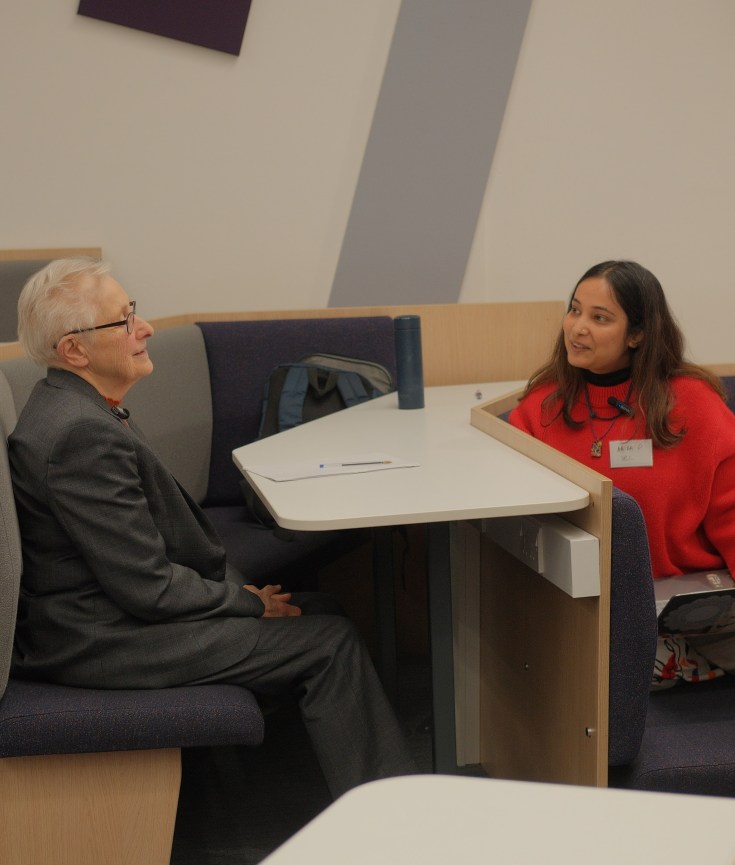
Cover photo of Marilyn Strathern in conversation with Abira Pathak, taken by Xihui Xu.
Cameraperson for Marilyn’s interview: Rie Kimoto
Cameraperson for Martin’s interview: Abira Pathak
These interviews turn around Temporalities, the theme of our 2026 print issue, which you can read here.

