
By
Ewan Martin-Kane
MSc Social and Cultural Anthropology
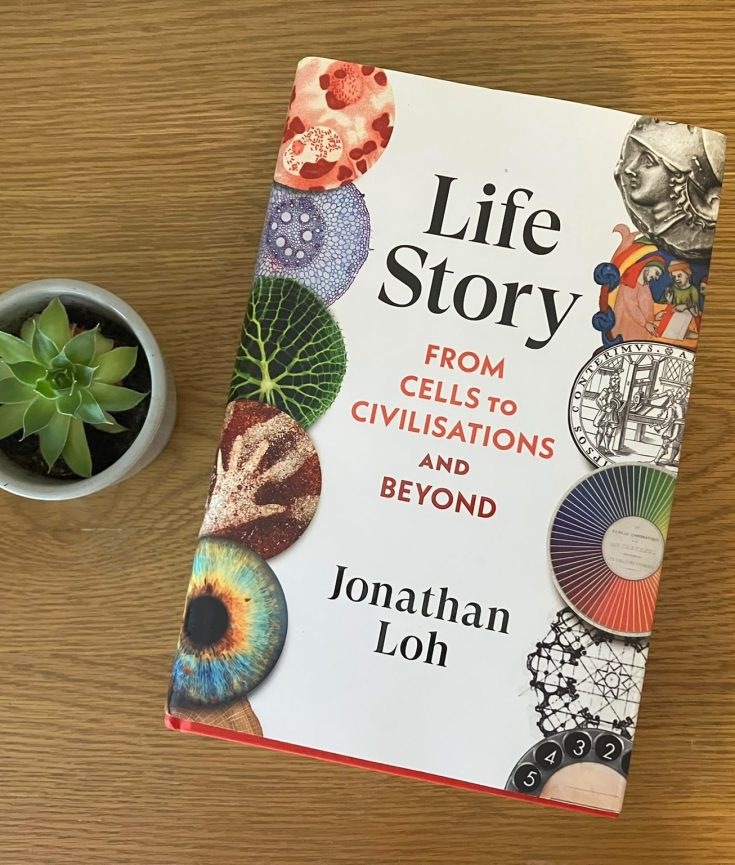
Dr. Jonathan Loh is a life enthusiast, that much is clear. He was one of the minds leading the WWF’s Living Planet Index, measuring trends in global biodiversity. His most recent project sprawls out further yet: in writing Life Story, he gives a panoramic reckoning of evolution, from the primordial soup to the present day, and beyond. As we merge with that awful, awesome Autobahn of automation, Loh takes a 400 page look in the rear-view mirror in order to ask, Well, how did we get here?
Loh’s thesis is that evolution didn’t just drive us here through genetics; the emergence of culture was an evolutionary vehicle too, which supercharged humanity’s relays of know-how, sprouting forms of communication that outpaced the work of genes. Now, in a third phase of evolution, machine intelligence offers/threatens to take the wheel, putting humanity in the passenger seat, or kicking us out on the hard shoulder.
It is this view of evolution which offers Life Story its chance of survival amongst the other species of how did we get here books, such as its closest known relative, Sapiens. Loh’s book has similar attributes to Harari’s apex bestseller – both take broad strides in covering their ground; neither work stoops very often for a citation. It will face many of the same challenges, but it is well adapted to the climate of 2026, in which we have many forms of survival to worry over.
Loh begins with the iconic shot from 2001: A Space Odyssey, of the bone thrown into the stratosphere, transforming to a space ship. Loh ventures to trail this parabola, and needs clean-as-a-bone prose to do so.
It’s a heady effort, but such was life’s course. Loh does not shy from talking up the stakes, and when he offers spectacles like “the tightest evolutionary bottleneck”, we can picture him at the ringside, giving us the play-by-play. It is an achievement to have condensed over 4 billion years of headlines into one narrative. And with steady, breezy prose which glimmers in the moments he can catch his breath.
Enjoy, for example, his description of the Ediacaran period, “a time when soft, sluggish jelly animals lived in warm shallow seas, grazing on microbial mats of bacteria, blissfully unaware of anything at all, including themselves” (Loh, 2026: 76).
Life Story works at vertiginous scales. Loh seems to see the magnificence of phenomena of all magnitudes: he noseys at the housekeeping of eukaryotes; he surveys the fall of the Akkadian Empire; he prospects the solar systems, all with the same fascination. Loh’s signature move is to overlap these scales, pointing out the analogies between phenomena, so that he can claim there really isn’t so much difference between a cow and a mitochondrion, as they both adapted to store energy for the “cell” which sustains them. Social evolution, for Loh, is more than metaphor: it is an intensification of evolution’s genetic mechanisms. This lineage of thought inherits from Haeckel’s Zellenstaat, Anderson’s social protocell, Pagel’s cultural survival vehicles, and James Scott’s multispecies resettlement camps (Haeckel 1934; Anderson and Törnberg 2019; Pagel 2012). It feels like generations of reading have fed Loh’s account. It is B.M. Kozo-Polyansky’s theory of symbiosis, substantiated by Lynn Margulis, which makes evolution scale up to a social process (Margulis 2011). Loh finds that, as sub-cellular organelles can merge to become an evolutionary vehicle, so too can cattle, cowherds, Big Dairy, etcetera, scaling up to the milky way, as far these networks of cooperation can stretch.
Tracing patterns across scales, Loh snaps together data points by folding in swathes of geological time. All analogy is a kind of compromise, and the cost of these bold sweeps is a flattening of difference.
It is this aspect that proves challenging to the anthropological reader, who is, perhaps, more interested in the anomaly than the trend, in all the differences that make the cow, a cow. Working at his pace and magnitudes, Loh doesn’t leave a lot of room for the differences between people and their cultural lives. When he does draw on anthropologists, such as Oliver Scott Curry’s work on universal values, he seeks general models for human nature (Curry, Mullins, and Whitehouse, 2019). His comparisons across culture is usually limited to logic of analogy or, moreover, competition. Bringing all of humanity into one experience of the “Anthropocene”, he loses his footing when pacing past ways of life that don’t abide by accelerationism, especially when trying to draw a difference between so-called “complex” and “simple” societies:
“To be clear, I’m not saying that complex societies are in any way better or superior or cleverer than simple ones. Sometimes, as we know, the opposite is true.” (Loh, 2026: 276)
He could do away entirely with the metric of superiority, which troubles the tone of his narrative’s encounters with colonialism. The time he spends weighing up whether European colonizers inherited their “bellicose” tendencies from Yamnaya nomads (Loh, 2026: 276) ….could have been better spent on the experience of the indigenous peoples who faced colonialism’s coerced forms of symbiosis. What are the risks of fitting colonialism into the analogy of cultural and genetic evolutions? This is a fundamental question for anyone framing social-evolutionary discourse – which has time and again been appropriated by the most harmful ideologies and pseudo-scientists. Loh doesn’t clearly ask himself this question in his book. His work would benefit from taking in more people’s version of life’s story, other understandings of evolution, and, indeed, of extinction.
I would also have liked to have read examples of communication networks which do not always strive towards efficiency of information transfer; systems which have persevered because their semantics are opaque (Geertz winks).
Loh tends to feature phenomena for their use-value as evolutionary vehicles (mice are described as “the mouse stratagem”). The cost of this, when Loh includes details out of sheer curiosity, the reader may be trained to wonder, “what’s this part for?” Yet it is ultimately these moments, when Loh holds up a vestige – a shipwreck, a flute, the Makapansgat pebble – which will carry forward longest in memory, just as fingerprints outlive a blow.
These inclusions are poignant retrievals, which show the author’s humanism vying alongside his posthumanist account.
It is this humanism which carries through to his final section on the emergence of artificial intelligence. I had been wary to reach this phase, but I was surprised to feel, for the first time, moved by the idea that the machine will supersede me.
Life Story seems to ratchet up with its subject matter, especially as Loh’s expertise on our environmental crisis comes to the fore. He uses his data to show the options that lie ahead for us, framing possible techniques that could fit homo sapiens for the age ahead.
Bernard Stiegler warned that with the machine’s ascendence, “the relation between anthropology and technics appears as a thanatology” (Stiegler, 1998: 125). Loh’s biography of all lifeforms closes with more hope than that. Perhaps I felt soft and aged from those billions of years Loh carried me through, but his account works to decentre humanity as the teller of life’s stories, which have, in Loh’s sense, been told for as long as matter and energy have kept up conversation. This conversation, he argues, could only survive to the next billenium, if the machine bears the torch. Clankergander? I have to say, Loh’s optimism feels earned, because it follows an unflinching summary of the costs of all that progress this planet has accrued.
Taking stock then shutting up the shop, Loh leaves one light on for his inheritors.
Life Story – from Cells to Civilisations and Beyond is available from Vintage, 27 September, 2026.
With thanks to Vintage for inviting Anthropolitan to write this review.
Bibliography
Anderson, C and P. Törnberg, 2019. Toward a Macroevolutionary Theory of Human Evolution: The Social Protocell. Biological Theory 14, 86-102.
Curry, S., Daniel Austin Mullins and Harvey Whitehouse, 2019. Is It Good to Cooperate? Testing the Theory of Morality-as-Cooperation in 60 Societies. Current Anthropology 60(1) 47-69.
Haeckel, E. 1934. The Riddle of the Universe. Translated by Joseph McCabe. London: Watts and Company.
Margulis, L. 2010. Symbiogenesis. A new principle of evolution rediscovery of Boris Mikhaylovich Kozo-Polyansky (1890–1957). Paleontological Journal 44(12), 1525-1539.
Pagel, M. 2012. Wired for Culture: Origins of the human social mind. New York: W. W. Norton & Company.
Scott, J.C. 2017. Against the Grain: A Deep History of the Earliest States. Yale: Yale University Press.
Stiegler, B. 1998. Technics and Time. 1: The Fault of Epimetheus. Stanford: Stanford University Press.

