

By
Dr Gabriella Santini
PhD Anthropology
“Interdisciplinary research is the key to addressing global challenges”, they say. So why did I feel like I was swimming against the current on my own interdisciplinary research journey?
I am a PhD anthropology student working at the intersection of biodiversity conservation and animal behaviour. My doctoral research examines how human-nonhuman interactions are shifting due to wildlife conservation initiatives, employing tools from both anthropology and ethology. Consequently, I’ve found myself working extensively with ecologists and biologists, both during fieldwork and within higher education spaces, such as conferences and workshops. Initially, I did not anticipate that it would be difficult, given anthropology’s inherently interdisciplinary nature. After all, our discipline blends methods and theories from the arts, humanities, social sciences, and natural sciences. Furthermore, anthropologists champion ‘knowledge co-production’, purportedly fostering openness and adaptability when venturing beyond their comfort zone. As such, the discipline has many geographers, biologists and natural scientists-turned-anthropologists.

Yet I’m consistently struck by my encounters with colleagues on the science side. Given that conservation has, for some time, been integrating social sciences into its framework, I was surprised to discover that we often seem not only to speak different languages but also to perceive the world through fundamentally distinct lenses. But this is not the issue, really. I appreciate that interdisciplinary research, as Daniel et al. (2022, 2) articulate, entails integrating “research methods, knowledge, assumptions, and frameworks from separate disciplines to address a shared research question.” Inevitably, there will be some communication issues that hinder collaboration, and we try to work past that.
What I mostly took issue with are the hierarchies of knowledge that still seem to permeate various academic disciplines – something also noted by Elixhauser et al. (2024). I often felt like my findings were considered ‘less valid’ than measurable, quantifiable data that can be neatly displayed on a graph.
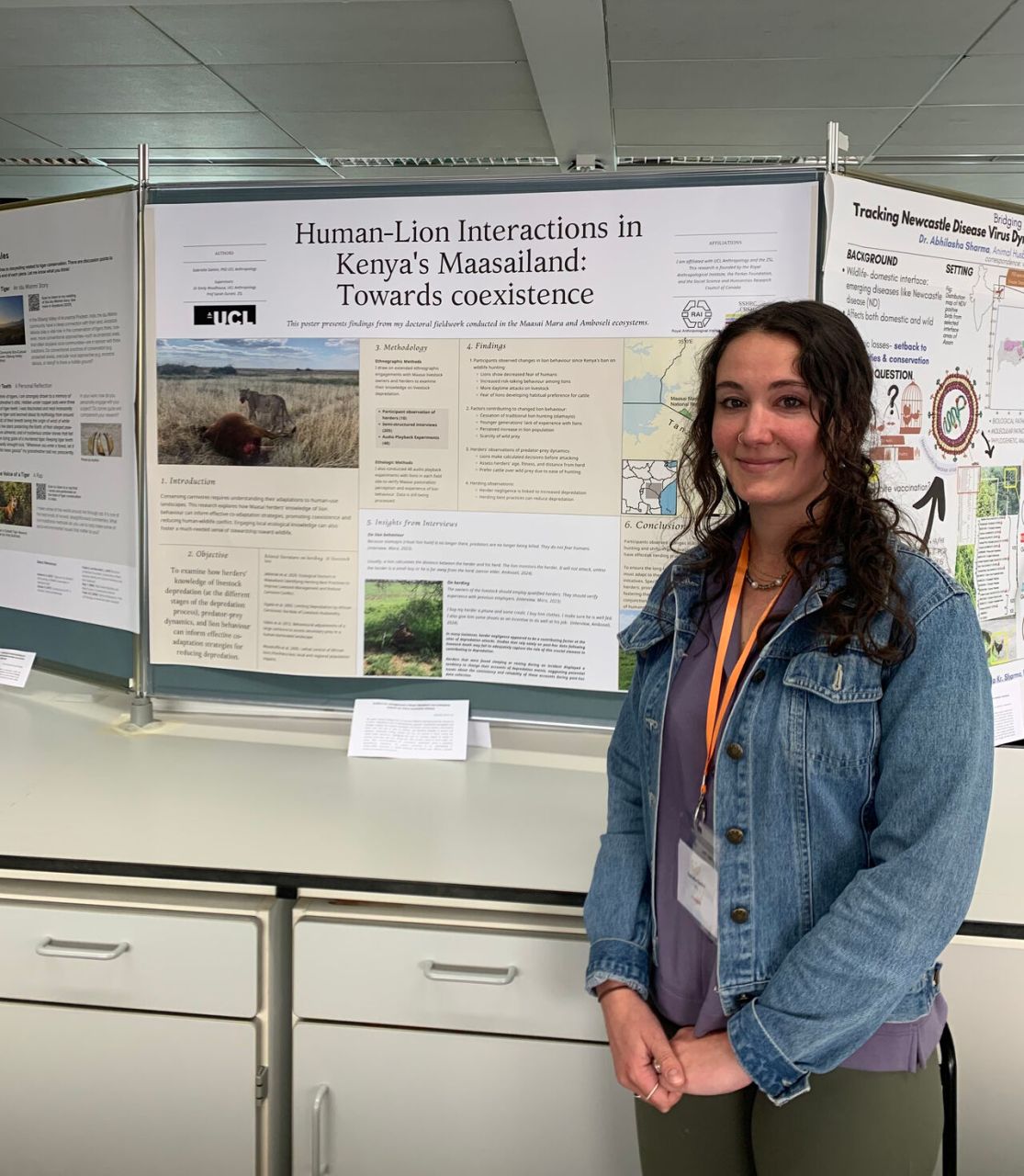
I was at a conservation conference in April 2025 attended by students from various fields across the globe, yet conservation social scientists were few and far between. I was the only anthropologist. The feedback I received from the conference judges on my presented project was: “Results feel a little qualitative/anecdotal.”
Reading those words, I was incensed. Despite the conference organisers’ professed openness to conservation social scientists, this comment felt remarkably tone-deaf. It displayed a profound insensitivity to the methods, evidence, and dissemination strategies central to the very scholars they claimed to welcome. I mean, social scientists produce exactly that: qualitative data. Not to mention that, as an anthropology student, I spent considerably more time in the field than most other students at the conference, learned two local languages, and forewent the comfort of a conservation base camp.
What’s particularly frustrating is that this isn’t an isolated incident. Throughout my four-year journey straddling social and natural sciences, I’ve encountered variations of these kinds of comments repeatedly: “Oh, you’re what? An anthropologist?” “Your data probably won’t be publishable in a ‘real’ scientific journal.” “You aren’t getting enough data points for your work to be meaningful.” And the list goes on.
This often fuelled self-doubt, making me question my ability to conduct my research correctly. I wondered whether conservationists took me seriously. Could they sense my lack of confidence? Would the fact that I am not a ‘real scientist’ bar me from accessing certain spaces, perhaps even my own field site? I am even afraid to commit these thoughts to paper, worried that the colleagues I made on the science side might read this and discredit my work.
Indeed, academia seems to be moving beyond disciplinary silos, with growing enthusiasm for projects that break out of traditional boxes. In fact, aspirations to increase interdisciplinarity feature prominently in UCL’s Strategic Plan 2022– 27. Yet, as an anthropologist who ventured into conservation biology, I can’t help but feel that this excitement is often more lip service than reality. Crossing disciplinary boundaries sounds great in theory, but in practice, it can be fraught with practical, ontological and epistemological challenges.
First, there are the awkward moments when you try to explain your project. Each time I attempted to articulate my work, I was met with puzzled looks – anthropologists questioning my methods and conservationists doubting my expertise. This made doing the PhD an even more isolating experience.
Second – and closely tied to the first point – is the struggle to secure funding. Interdisciplinary projects often fall between the cracks of established funding categories (Bromham et al. 2016; Daniel et al. 2022). Funders seem wary of proposals that don’t fit neatly into a single discipline, making it harder for researchers like me to access resources for innovative work. As a result, the relentless pursuit of funding can hamstring interdisciplinary researchers like myself, diverting time and energy away from actual research and inevitably impacting the quality and quantity of our scholarly contributions.
Third, there are loads of academic barriers, including the timeframe given to complete your project. Interdisciplinary projects take more time: “Time is needed to find interested collaborators, generate a shared language and goal, and read unfamiliar literature” (Daniel et al. 2022, 3). I still had to undertake a year of ethnographic fieldwork on top of the four months of ethological fieldwork with lions I had to conduct. Because of the lack of funding and time, I was under extreme pressure in my field site and struggled with my mental health. Not to mention the difficulty of finding outlets for publication: journals tend to be discipline-specific, which leads to fewer citations for interdisciplinary work (ibid.). Once we do get published, we are expected to be familiar with and adapt to different writing styles and evidence standards.
Finally, there’s the imposter syndrome. It’s that persistent voice inside your head that undermines you as you’re struggling with the practical realities of points one, two, and three. I had constant doubts about my capability to do things right. As Borden et al. (2011) note, what constitutes ‘knowledge’ and ‘evidence’ is a cultural construct determined by discipline; each field has developed its own standards for what constitutes high-quality work. I feared I’d give myself away if I didn’t meet those standards or know how to speak their jargon.
In the end, I made it work. I completed my fieldwork, though much later than my colleagues, and have submitted and defended my thesis on time. I am proud of the network I’ve built for myself, and the project that emerged from collaborations with Maasai communities and conservation practitioners. However, feeling like I was constantly fighting time and funding, I haven’t been able to participate in as many conferences, seminars and workshops as my peers. I truly believe that undertaking an interdisciplinary project has set me back professionally, rather than bolstering my career, though only time will tell.
If the very institutions (e.g., universities, funders, workshop and conference convenors) that champion interdisciplinary collaboration simultaneously perpetuate disciplinary silos, what future awaits anthropologists who dare to explore other disciplines, theories, and methodologies? And what about researchers from outside anthropology who wish to adopt our ways of thinking without feeling like they’re, in the words of Chua et al. (2020), ‘co-opting’ social sciences?
Interdisciplinary research needs more than just enthusiastic rhetoric. It requires structural support. Funding bodies must recognise the value of boundary-crossing work and offer targeted grants for interdisciplinary projects at every level, whereby reviewers must actually be open to creativity and unorthodoxy as opposed to applying the standards of their own discipline (Daniel et al. 2022). Moreover, academic institutions should give researchers undertaking unconventional or interdisciplinary work more time to complete their projects, including getting published and attending conferences. They should also foster environments where researchers feel encouraged, not alienated, to step outside their comfort zones.
For me, becoming an anthropologist-turned-ecologist was not just about learning new methods. It was about embracing uncertainty and finding ways to connect across epistemological divides. It was messy and uncomfortable at times, but it also opened doors to collaborations that enriched my perspective on conservation, science and anthropology. Most importantly, my project resonated with the Maasai communities I worked alongside, because it was designed with them in the end. And to me, that’s the partnership that matters the most.
References
Bechtel, William. 1986. “The Nature of Scientific Integration.” In Integrating Scientific Disciplines, edited by William Bechtel, 3– 52. Dordrecht: Martinus Nijhoff.
Boden, Daniel, Maura Borrego, and Lynita K. Newswander. 2011. “Student Socialization in Interdisciplinary Doctoral Education.” Higher Education 62 (6): 741– 755.
Bromham, Lindell, Russell Dinnage, and Xia Hua. 2016. “Interdisciplinary Research Has Consistently Lower Funding Success.” Nature 534 (7609): 684– 687.
Chua, Liana, Mark E. Harrison, Hannah Fair, Sol Milne, Alexandra Palmer, June Rubis, Paul Thung, et al. 2020. “Conservation and the Social Sciences: Beyond Critique and Co– Optation. A Case Study from Orangutan Conservation.” People and Nature 2 (1): 42– 60.
Daniel, Kristy L., Myra McConnell, Anita Schuchardt, and Melanie E. Peffer. 2022. “Challenges Facing Interdisciplinary Researchers: Findings from a Professional Development Workshop.” PLOS ONE 17 (4): e0267234.
Elixhauser, Sophie, Zofia Boni, Nataša Gregorič Bon, Urša Kanjir, Alexandra Meyer, Frank Muttenzer, Mareike Pampus, and Zdenka Sokolíčková. 2024. “Interdisciplinary, but How? Anthropological Perspectives from Collaborative Research on Climate and Environmental Change.” Environmental Science & Policy 151: 103586.
This piece is a response to Temporalities, the theme of our 2026 print issue, which you can read here.

